Here is a view from the middle of town looking back towards the direction of Chendgu [east?].
Sunday, May 29, 2005
Anjue Si monastery, Kangding
This is one of the main monasteries in Kangding, and is right in the middle of town. It also runs a guesthouse [The Black Tent Hotel] and coffee bar!
Buddha figure at Anjue Si monastery, Kangding
The serene face of a Buddha figure seen in Kangding before my departure to Jiulong.
A river runs through it ...
The mighty Kangding river that runs smack through the middle of town and takes no prisoners whenever there is a flood.
Kangding
Kangding is the hill town where many of the interesting treks in Joseph Rock's footsteps start from. Minya Konka, the Yalong Canyon and even the Konkaling ranges all pass through here. In Rock's day it was known as Tatsienlu, a sinicised form of the Tibetan Darsendo.
Monday, May 23, 2005
Coming up: Mongdong [猛董] and the Yalong Canyon [雅砻江]
Stay tuned for the full account of my recent trip to the Yalong canyon and the beautiful mountain of Maidi Gangga [麦地贡嘎, Muti Konka]. Joseph Rock described it as a "scenic wonder of the world". Nobody has seen it since he went there in 1927. Except me.
Friday, May 20, 2005
"Yeti temple" [野人庙] in Tibetan Sichuan
These Pumi people are building a temple to honour the "wild man" (yeren [野人] or yeti) that is said to frequent this remote mountain district near Jiulong. It's a day's drive south of Kangding.
Yeren Miao [Wild Man Temple], near Jiulong in Sichuan
About an hour's drive and a 40 minute walk up a bumpy farm track southeast of town, this small temple is built in a cave, half way up a cliff. Local legend has it that the local people knew of the cave and its spring of "holy water" many hundreds of years ago, and visited it to pray for a good harvest. Then one day some primitive statues and simple structures appeared overnight. No one knew who did it, and it was attributed to the "Wild Man" or Yeren - the Chinese term for yeti. Another version I've heard is that the term wild man" was used to describe an unkempt hermit who lived in the cave, meditating for many years and whose personal hygiene and apparel - and perhaps his attitude - were somewhat, well, wild. You can now see the yeti's big footprints and hand [paw?] prints, enshrined in the small temple, reached by a short but steep walk up the cliff path. There is a fancy new temple being built at the foot of the cliff - go past it and look for the track branching off to the left, over a stone bridge.
If you want to make your own way to the temple, take the left fork from the main street just after the public toilets. You can't miss the smell!
Cave shrine with yeti footprint
This shrine contains what is said to tbe the footrpint [or pawprint?] of the "wild man" or Chinese yeti that is venerated at the temple. See for yourself.
Yeti's eye view - from the Yeren Miao
Looking back north west towards Jiulong. In the distance on the right is the new temple.

View of the temple from below.

The newly built temple below the old cave shrine on the cliff.

Approaching the Wild man temple from the valley out of Jiulong.

Yeren Miao from in front. The temple is built into a cave in a cliff, and the cave has a holy water spring in it.

The "Yeti Temple".
Saturday, May 14, 2005
Wuxu Hai (伍须海), near Jiulong (九龙) in Sichuan, 2004
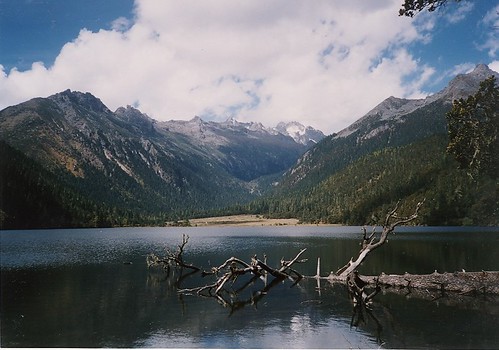
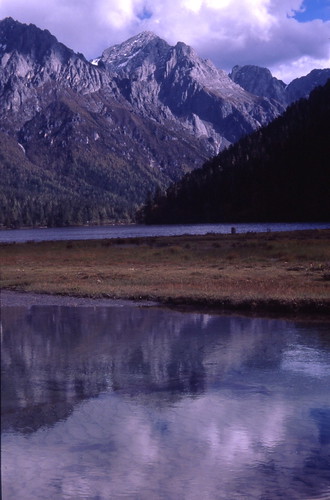
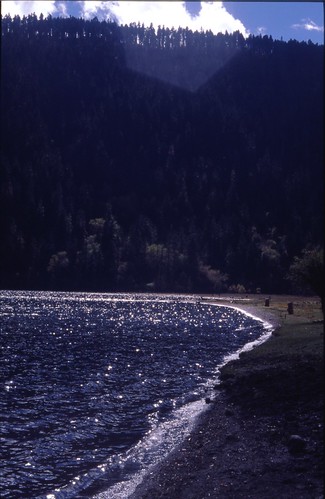
Wuxu lake is a pristine alpine lake about a day's ride on a bus south from Kangding. It is surrounded by mountains of about 18-20,000 feet high and there are a few Tibetan herders living around it. It is a beautiful and unspoilt spot, but for how much longer remains to be seen. This is the view from the near shore, a short walk from the rough and ready "visitor centre" with its restaurant and log cabin accomodation.
If you want to find out more, there is my Jiulong travel guide summary hosted at the fabulous Chinabackpacker:
Wuxu Hai (伍须海) - northern shore
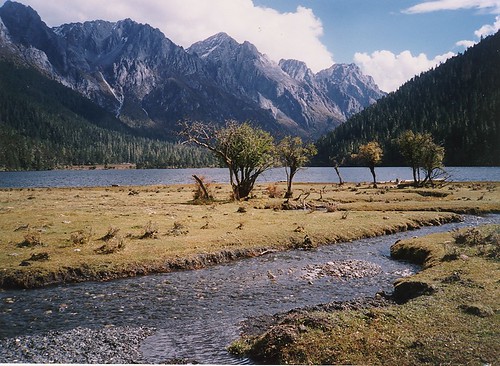
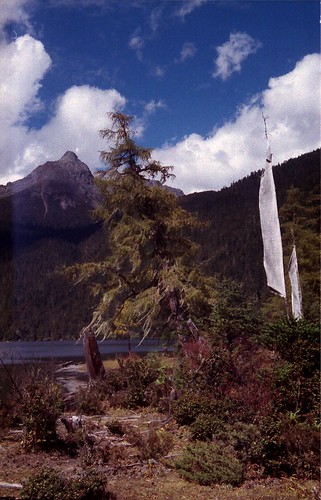
On the far shore of the lake is a smallish grassy flat with a couple of Tibetan log cabins. This is the view from there towards the "Twelve Daughters" range of peaks.
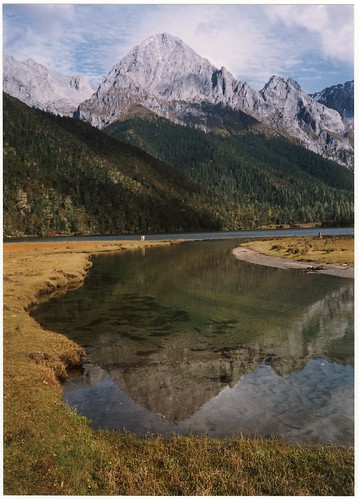
Wuxu Hai views
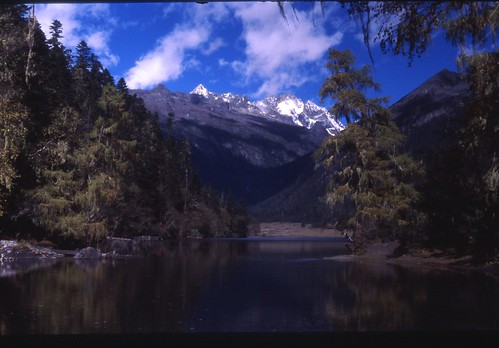
"Twelve daughters" mountains (十二姑娘), Wuxu Hai, near Jiulong, Sichuan
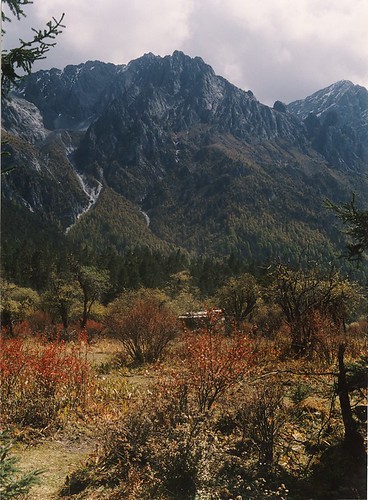
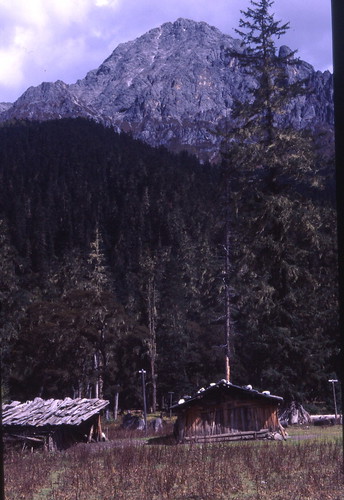
Hut below Wuxu Hai
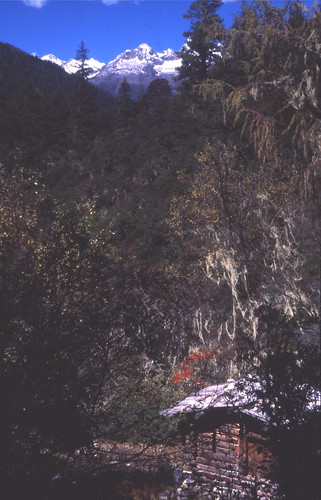
On the road up to Wuxu Hai from the lower village you get some tantalising glimpses of peaks in the distance.
Lower Wuxu village
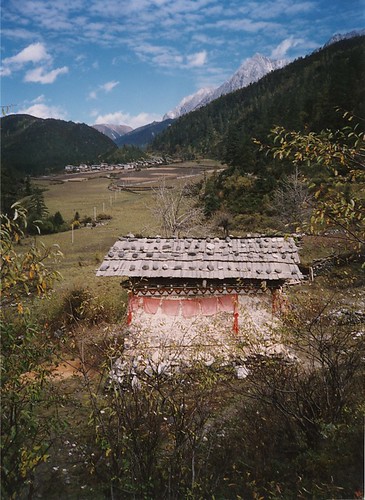
About 5km below Wuxu Hai there is a small Tibetan village known as lower Wuxu. There is a small store here and some holiday cabins being built.

At lower Wuxi village we tried to hitch a lift back to Jiulong but there was no traffic. In the end we paid a couple of local guys to take u s on the back of their motorbikes - one of the scariest and most foolish journeys I've ever taken. It's hard to keep your balance on a motorbike when you have a 15kg backpack on and you're riding over potholes without a helmet.

Looking up at one of the "12 daughters"
Wuxu Hai child labour
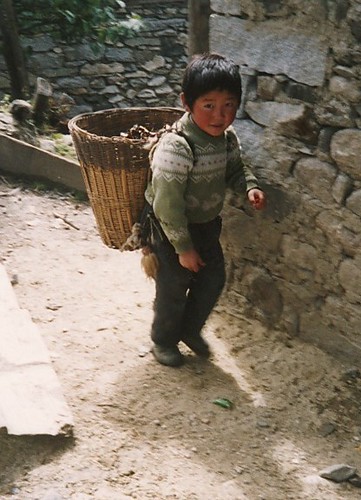
In the village below Wuxu Hai I snapped this young kid already at work in the fields with a basket full of corn stalks on his back.
Rock painting near Wuxu Hai
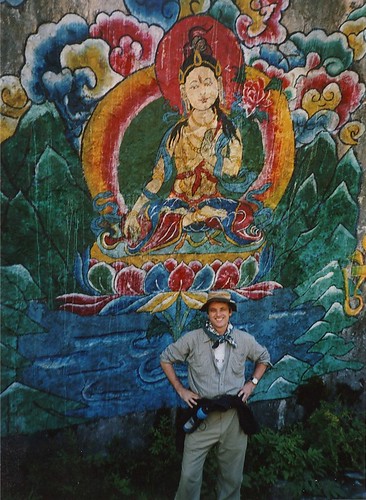
About 3km down the hill from Wuxu Hai in the forest by the roadside is a huge rock covered with Buddhist deity paintings and festooned with white scarves and prayer flags. It is circled by devout pilgrims and cheesy looking tourists from Leeds, like the one above.
"Black limestone peak"
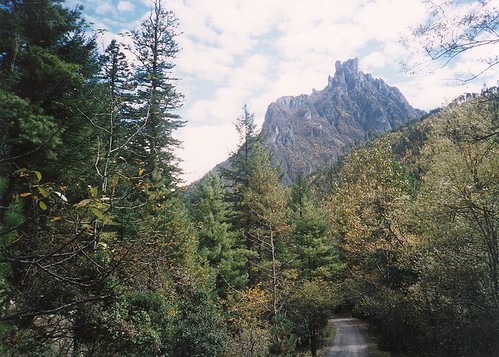
On Joseph Rock's hand-drawn map of the area, he has marked on some "black limestone peaks". Sure enough, on the 20km dirt track up from Jiulong, here they are.
Trees with lichen around Wuxu Hai
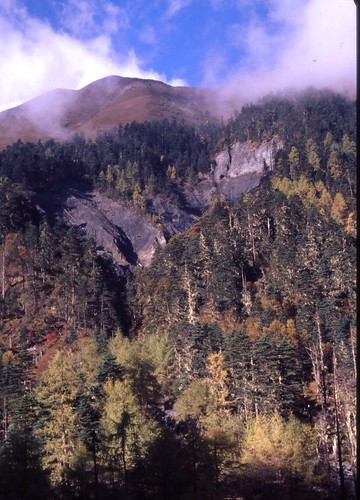
The trees around the lake are festooned with beard-like lichen known as muluxiu. This picture was taken in early October. The best time to come fro the autumnal colours is late October and early November.
The shores of Wuxu Hai
On this picture you can see some of the makeshift rubbish bins. There are also a couple of tacky plastic paddle boats moored out of sight.
Tibetan woman at Wuxu Hai
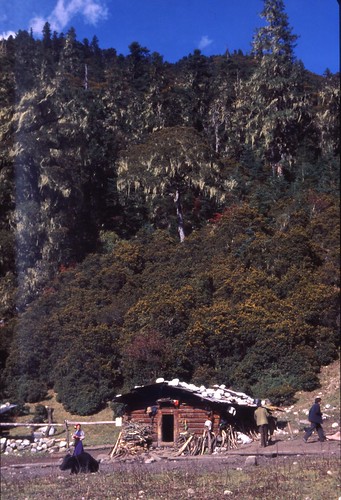
Conversations in a log cabin at Wuxu Hai
I spent a pleasant if rather knee-breaking afternoon with this chap, called Yao, in his house at Wuxu Hai. We sat there chatting over a cup of butter tea about China and Australia and Joseph Rock. His uncle, Yao senior, dropped in to pass the time of day. He was the village leader and seemed very clued up about world events. He scolded me for being British and having forced unequal treaties on China in the 19th century! When I told him I now lived in Australia he said he had seen it on TV ["as good as visiting"] and thought it looked like a nice place. But he wouldn't want to live there.
He also told me that George Bush was "contributing to a negative trend in international relations". So much for getting away from it all!
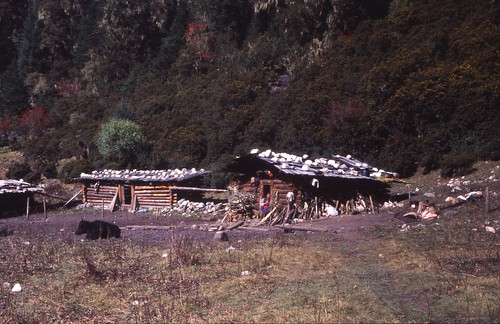
Log cabins at Wuxu Hai
Thursday, May 12, 2005
Coming up next: Wuxu Hai (伍须海)
In the next week or two I will post some pictures of the beautiful Wuxu Hai [lake] near Jiulong (九龙)in Sichuan province. Joseph Rock passed this way on his journey from Lijiang to Minya Konka. Surprisingly he made no mention of the lake itself in his account of the trip.
I went there last year on my way to Muti Konka. It's becoming the new Jiuzhaigou - go there before the hordes discover this little gem.
The main attraction of Jiulong is the Wuxu Lake, about 25km north west of town along a dirt track. This can be reached in about 90 minutes by car or jeep, which can be hired outside the Longhai Dajiudian for 100 kuai one way/200 return, if you want to be picked up again next day. There is no bus service.
The road to Wuxu Hai follows a narrow forested river valley past limestone crags up to the picturesque village of Wuxu, where there are some tourists cabins being built (not operating yet in Oct 2004). From here it continues up to a few newly built tourist log cabins right at the lake. The last 5km is quite rough road and some car drivers may dump you at the village and tell you to walk the last bit. It’s a nice walk, passing a huge rock covered with colourful Buddhist deity paintings that locals circle round.
Wuxu Lake is an idyllic scenic spot, flanked to the south by a long range of grey peaks called the 12 Sisters, and with an expanse of paddock leading down to the [as yet] unspoiled waters edge. On the opposite side of the lake (reached by a track on the eastern – ie right hand side of the lake) the valley continues up to be lost in the snowy peaks of 18-20,000 foot high mountains. It’s all very Shangri La.
You can stay at the lake in some log cabins just built for tourists, starting for 20 kuai for a primitive dorm (just one big bed!) to 40-60 kuai for doubles. All blankets etc are supplied, but you could bring a tent if you wanted – it would be perfect for camping and trekking here. The log cabins also have a dining hall where you can get good meals such as beef, lamb etc for 25-30 kuai. Beer is also available, as witnessed by the huge pile of empties formed into a pyramid outside the kitchen shack. There is no shop so take everything else you might need.
The “resort” is run by Jiulong local government, and they are trying to be eco-friendly and use natural, local materials. They have installed a lot of bins in the form of hollow tree stumps, but the first Chinese visitors seemed to be ignoring these.
The guy who runs the cabins is a Yi and his hardworking wife is very friendly, despite having to cope with a son who is both blind and crippled.
The Tibetan locals will nag you relentlessly to “Qi ma” - ride their horses . They do rides up to a waterfall about 30 minutes on from the other side of the lake, and beyond to hot springs where you have to build the pool around yourself with boulders from the creek. You don’t need to ride a horse – you can find your own way quite easily by just locating the well trodden tack that bears off from the middle of the forest. The locals will charge you about 50 to ride up there on horses.
It is also possible to walk/ride up the surrounding forested hills to various lookout points, popular with professional photographers, with great views over the lake and mountains. These tracks are hard to find unless a local shows you.
There is also said to be a beautiful lake, “Tian Chi” (天池) that is sacred to the locals, about six to seven hours ride up the valley into the mountains on the opposite side of the lake. I didn’t go there, because you need to camp overnight and take all your own gear.
Word of warning: there are some Tibetan’s log cabins on the other side of the lake, where the canny locals invite you in for a cup of butter tea made with milk fresh from the yak. It’s fascinating if you’ve never been inside a Tibetan house before, to sit around the fire. But the friendliness can come at a price – of 10 kuai per cup! Ask first “Shou qian ma?” (Do you want money?).
You can arrange for a car to come and pick you up, or if you are fit it’s possible to walk back to town in about four-five hours. Quite a few day visitors leave around 4pm, so you may be able to hitch a lift – but don’t bank on it!
Here are some "postcard" samples of excellent Wuxu Hai pics posted by 徐作军 at the xitek website:


Mt Kawakarpo (卡瓦格博) map - outer kora
If you want to do the full pilgrimage circuit [kora] around Mt Kawakarpo then here's your map. It covers the crossing of the Doker La, and the whole trip will probably take you a couple of weeks!
Map of the Kawakarpo inner kora [pilgrimage circuit]
For anyone who is interested [and can read Chinese] - this is the route of the inner kora around Mt Kawakarpo, or Meilixue Shan.
Monday, May 09, 2005
A side trip to Yubeng (雨崩)
Unable to cross the Doker La because of heavy snow, we made our way up a scary knife edge road up the Mekong canyon to Deqin (德钦). Passing through Yunling (云岭), the scenery down into the gorge was absolutely breathtaking. It seemed like a mile deep. I would have enjoyed it more, though, if I hadn't been so worried about our bus coming off the road.
Resting up in the rather utilitarian town of Deqin, we stayed at the Tibetan Family Guesthouse at the bottom of the main street and stocked up on food and internet surfing. The internet bar was full of snotty Tibetan kids playing the Counterstrike online game. Surreal.
Deqin 2001
Deqin, 1924
From Deqin we hitched a lift up to the Feilai Si (飞来寺)monastery, which sits on the edge of the valley and looks over to Kawakarpo [Meilixue Shan 梅里雪山]. We rested at the teahouse there watching pilgrims and tourists coming to burn a forest worth of juniper bushes at the ceremonial chimneys. 


The old lamasery at Atuntze [Deqin] in 1924.


We then descended the huge drop on a snaking switchback road, down to the floor of the valley and over the Mekong to go to the village of Xidang (西当). After a brief stopover at the "Jungle Temple" we took the left [southern] fork of the dirt track to Xidang. The right fork went up to the tourists viewing area of the Minyong glacier (明永冰川).
The road to Xidang was even more scary than the one up from Cizhong to Deqin. It was only a couple of km, but it was a very narrow gravel track with a sheer drop of several thousand feet down to the river on one side. Very airy!


The same scenery in 1924


Xidang
Disembarking at Xidang we made our way up through this small Tibetan village into the foothills above town, and hiked up for a couple of hours to the hot springs. These few bathing sheds were run by a Sichuanese guy who seemed extremely bored with his post. It was very cold and damp there, so the warm baths were a welcome chance to get the circulation going - at least temporarily.
The next day at the hot springs we met some New Yorkers who had just hiked back from Yubeng. They ran the GORP outdoors website and were raving about how beautiful Yubeng was. They headed off almost straight away in their nice hire jeep, making us feel very impoverished dossers after our 15 kuai bus ride to get there!

For most of the afternoon we hiked over the lonely trail to Yubeng and got a few glimpses of mountains on the way. But for the most part the weather really socked in for the next few days and we saw nothing but fog and snow. There was nothing to do except play snooker at the Yubeng village table, which was sheltered from the incessant drizzle by a few planks of pine and a tatty square of polythene. 

Shanti: snooker champion of the upper Mekong
Bored with that, and of sitting around the [not very effective] fire all day in the kitchen of the Yubeng guesthouse, we made an ill-advised excursion up the valley to try see a sacred waterfall. Instead, we ended up going to a sacred lake, which turned out to be more of a pond, and was almost completely snow covered and frozen. I was not in the best of moods when we returned, especially as I had water sloshing round in my boots. Another day of rain was spent looking in at the tiny local school, where kids were learning Chinese and Tibetan. After three days of this, and a diet consisting exclusively of eggs and flat momo bread, we decided to bale out.


Things were not much better when we returned to Xidang. We stayed the night in the main guesthouse there, and spent a pleasant evening watching the local Tibetans rehearse in mufti for their annual festival. But the young Xidang punks started getting out of hand when the music turned to disco, fighting and posturing. Boredom, drink and aggression - small country towns are the same the world over.
Unfortunately our room was right above the disco and the music went on until 4am, by which time I had packed and left. Stupid move as I didn't realise that in Tibetan villages they bar the gates of the houses and let the huge dogs roam the trails - so I spent a petrified cold night under the eaves of the village store trying not to attract the attention of the local Hounds of the Baskervilles.
Yubeng.
The mountain worshipping lady of Yubeng.

The long road home: Deqin to Zhongdian bus. Note the Dalai Lama picture on the windscreen.
Sunday, May 08, 2005
First stage of the Dokerla (多克拉) trek
After we visited Cizhong we walked north for a day along the road towards Deqin that followed the Mekong. We wanted to find the entrance to the Londjre gorge and possibly tackle the Doker La. We found the entrance to the gorge all right [see black and white pic below] but it was over the river and we couldn't get across! There wasn't even a rope bridge - or anyone else there. Instead, we continued on for about 5km to a small village just south of Yunling, where there was a small bridge over the river.
He we crossed, saw the small temple, and hiked up to a small village called Yongju. Here we ran out of steam - it was late in the day and the clouds had completely covered the ridge so we didn't know which way we were going. We stayed the night at a local farm, where the farmer told us the Doker la was compately snowed in for another month [it was mid April]. So reluctantly we turned back the next day and returned to the road, where we caught the daily bus to Deqin.

View from the river at about 2000m, looking up towards Yongjiu (永久).

A view up to the ridge separating the Mekong and Nujiang, from near Cizhong.

The good farmer of Yongjiu (永久) who put us up for the night and let us sleep on his floor.
Some scenes from the Salween (Nujiang) in Yunnan
These are taken by photographer Shen Che from the book Life Among the Minority Nationalities of Northwest Yunnan.

Path cut into the wall of the sheer-sided canyon

A curve in the river surrounding Biluo Shan.

The village of Qingnatong.

Mortar and pestles grind corn at harvest time.

Corn is the staple food of the Nu people.

A village on the upper Nujiang
Saturday, May 07, 2005
Over the trail to the Salwin (怒江) river
Summary: After Cizhong, Joseph Rock headed west, crossed over the 15,000 foot high Sila pass to the Salwin river [now known as the Nujiang 怒江] and explored some of the monasteries and towns there. He then returned to the Mekong via a treacherous gully he called the Londre gorge. And finally he made another westward excursion to climb the now famous Doker La [多克拉] pilgrimage trail that traditionally marks the border point between Yunnan and Tibet. There he caught glimpses of the southern end of the 6740 m Kawakarpo mountain range, which he later viewed and photographed from what is now Deqin 德钦 - then known as Atuntze.
Leaving most of his supplies behind he ascended first from the Mekong river up a steep zig-zagging track through oak and pine forests to a ridge about 11,000 feet up. From here he had great views of the Baimashan mountains south of Deqin. Continuing up to the bleak Sila pass, he passed through deciduous forests of maples, with wild cherries and rhododendrons growing in the bush. And again there was that beard-like lichen covering the trees as is seen throughout much of Kham. The next day he crossed the Sila pass in a snow storm, but not before seeing a triangular overhanging peak to the north. 
From here they descended into the Salwin valley and to an even more remote Christian missionary outpost known as Bahang, or Peihanlo in Chinese. A well-made trail had been constructed under the instruction of the French missionaries who manned this most lonely and remote spot. 
A village church in the high country between the Mekong and Salween [Nujiang] rivers.
First, though Rock had to cross some subsidiary ridges and tributaries that flowed into the Salwin - the Sewalangba and Doyonlangba rivers, where they stayed in a mountain hut which may well be the one that trekkers still use when crossing this route. For a map of this route and account of one American's crossing of it you can link here.
On a bluff above the Doyonlongba Rock finally reached what he described as "the loveliest mission station of which I know" - Bahang. 

There are some superb photographs of Bahang [now known as Baihanluo 白汉洛] by Gerald Buthaud here
At Bahang a young priest, Pere Andre, a veteran of the carnage of the First World War, lived in isolation, cut off from the outside world from November to May. Bahang was a collection of 18 huts and is still there today, complete with its beautiful Catholic church, above Dimaluo (迪麻洛) in the Nu valley. According to Rock it had twice been burnt to the ground by the Tibetan lamas of nearby Champutong monastery. In retaliation for this, the Chinese had burnt down the Tibetans monastery. Sectarian strife was common in this little corner of Yunnan in the early 20th century. Here's how it looks in 2008, pretty much unchanged:
The "Lutzu" people that Rock encountered in the Salwin (Nujiang) valley he described as a poor lot who subsisted on corn, even using it to make liquor "of which they drink a great deal". 
Some Lutzu people Rock encountered in the Salwin [Nujiang] valley.
Rock continued on up the Nu river, first to Chjonra [across the Nu river from the present location of Gongshan 贡山], where he encountered a drunken gathering to celebrate the sale of a woman to become one of the many wives of a local Lutzu man. The inebriated locals ferried Rock and his helpers across the Salwin in dugout canoes.
Continuing north, he arrived at the burnt out monastery of Champutong [perhaps the present day Bingzhongluo 丙中洛], where only four monks remained to take care of what had once been a major temple. The scenery here was now tropical, Rock noted, a major contrast to the cool uplands of the Mekong valley he had left a few days ago. The Salwin river had carved out a "marble gorge" with walls that rose vertically for several thousand feet. The trails was a perilous shelf in places only as wide a man's hand, which meant tip toeing sideways along the canyon, facing the wall, while the river roared below.

Views of the Salwin river [Nujiang]
The next day Rock climbed up to the western watershed between the Salwin and the Irrawady (presumably he means the Drung or Dulong river) to photograph the 20,000 foot high Mt Kenyichunpo阳[see picture at top of post], which he claimed was only visible in October and November. It stood on the ridge that now border between China and Burma. Here Rock also encountered outposts of Lisu hunters, young boys who used arrows tipped with poison from the aconite root.

Across the divide he heard stories of a strange tribe, the Kjutzu, "a primitive harmless jungle people who the Chinese say live in trees like monkeys." This is presumably a reference to the Drung or Dulong [独龙] people, who are short in stature, had facial tattoos and who live in houses raised off the ground. They were for many years a kind of lost tribe, until a road was put in over the divide to connect the Drung river [独龙江] and Nu valleys.
With winter encroaching, Rock then headed back towards the Mekong valley before the passes became snowed in. He returned down the narrow canyon to what is now the large town of Gongshan [贡山]. Back then he had to fire his pistol to attract attention to the locals across the river to bring their dugout canoes over to ferry him to the eastern bank.
On the return journey, instead of crossing via the Sila pass, he branched off after ascending though walnut and rhododendron forests to the Salwin-Mekong dividing range. He headed into a deep valley funnelling into a narrow gorge and village called Londjre. His guides refused to go there, saying there had been an outbreak of the plague. Rock did indeed find this hamlet deserted, but on account of a plague of lice that harboured relapsing fever. This tiny settlement , deep within a dark gorge and full of disease, must have been a chilling place.
Londjre gorge entrance in 2001
Back on the banks of the Mekong, he was amazed to see large numbers of Tibetans crossing by way of the rope wires sliders. They were coming to make a pilgrimage to the Doker La [多克拉] pass. Rock made his way along the bleak Mekong gorge at this point, where high winds threatened to blow travellers off the narrow trail and into the river. He was greeted by Tibetan pilgrims with the traditional open palm and tongue gesture. His description of the area around Londjre deserves repeating in full:
"Of all the trails along which we had passed so far, none could compare with that which leads from Londjre gorge out into the Mekong. It is a veritable corkscrew up a weird black chasm, at the bottom of which roars the stream coming from the sacred Dokerla. The trail is built against a rocky wall of sandstone in short rocky zig-zags, a most appalling structure of tree trunks suspended over the deep narrow yawning black canyon with overhanging cliffs. A gale was blowing in addition, which meant that one had to brace oneself against the wind, holding on tightly to the cliff."

From the Mekong valley Rock gained even better views of the southern most peak of the Kawakarpo range, known as Miyetzimu [面茨姆], a 6055 metre peak which he described as:
"The most glorious peak my eyes were very privileged to see; no wonder the Tibetans stand in awe and worship it. It is like a castle of a dream, an ice palace of a fairy tale, or an enormous mausoleum with gigantic steps and buttresses all crowned by a majestic dome of ice tapering into an ethereal spire merging into the pale blue sky. Next to it is a huge crest of ice resembling a giant cockscomb, then comes Kaakerpu, from which the range derives its name."

Miyetzimu

Kaakerpu [Kawakarpo 卡瓦格博 or Meili Xueshan 梅里雪山]
Rock made an ascent of the Dokerla from Yangtza, along with a stream of of Tibetan pilgrims. Some of these he claimed threw themselves to their deaths down the steep Tibetan side of the pass, "for to die on that sacred spot means emancipation and deliverance from re-birth".

Joseph Rock at the Doker La
He noted that some Tibetan nuns and monks did nothing else than continually cross the Dokerla in pilgrimage, prostrating themselves on the ground and then drawing themselves up again.
"It seems that the Tibetans alone of all the religious people of the world heed St Paul's admonition 'Pray without ceasing'," he noted.
And with that, Rock returned to his Lijiang base, via the small town of Atuntze [Deqin], then an collection of flat-roofed Tibetan houses.
On the way back he became one of the first westerners to trek through the Tiger Leaping Gorge. This famous tourist attraction he described as the finest of all the gorges of Yunnan, but he never mentions anything about the legend of the tiger. Little did he know that this isolated canyon spot would one day become almost as popular as the Grand Canyon in the US.

Map of the crossing from the Melong to the Nujiang

Tibetan porters in the snowy valleys near the Dokerla

Qingnatong monastery

Tibetan pilgrim on the Dokerla

The Dokerla, looking towards Tibet.

Dokerla Pilgrims

Monks at Champutong

The chief lama of Champutong monastery. It was destroyed by the Chinese after the Tibetans massacred Christian missionaries in the area in 1905.

Crossing the Mekong by dugout canoe, near the present day town of Gongshan.
Thursday, May 05, 2005
The Mekong narrows north of Cizhong
This narrow gorge was formed by the steep walls of the hills enclosing the river as we walked north from Cizhong.
"The rope toboggan has no terrors for this Tibetan"
In crossing, the traveller sits in a sling with his hands placed over the wooden slider or grasping the leather thongs to which it is attached. If his hands touched the rope, the friction would burn or lacerate them. Both rope and slider are greased with yak butter to facilitate the crossing." - JF Rock, 1925.
The business end of a rope crossing of the Mekong
If the rope is crossed or a braided bamboo ring is tied to the rope in the centre above the river, this means the bridge is unsafe. This Chinese soldier and two Naxi assistants accompanying Rock were reluctant passengers.
Even Rock's 15 horses and mules were despatched across the Mekong in this way

In 2001 we saw there were still many people crossing the Mekong [Lancang Jiang] in this way.
Another Mekong view
Must be early in the day - the sun is still in the east and hasn't risen high enough to light up the bottom of the canyon.
Priest at Cizhong in Yunnan
This was taken by a Chinese guy at Cizhong. I don't know his name but his web moniker is poolfish.
Monday, May 02, 2005
Cizhong - A Christian Shangri La in Tibet - or the forefront of the next Cold War?
When I stumbled across the Catholic church at Cizhong (茨中) three years ago I knew little about its history or its unique significance. I was more interested in following the trail set by Joseph Rock over the Dokerla pass, and this lonely outpost of Christianity on the China/Tibet border was of curiousity value only. I had seen a few blurred pictures of it on the internet and knew that it had been established by French missionaries about a hundred years ago.
When we arrived at Cizhong after a pleasant if somewhat erratic bus ride up the Mekong valley, we were dropped off at a small suspension bridge over the river. We crossed this and headed up over the crest of a hill to find the village of Cizhong clustered around a village square that doubled as a basketball court and outdoor waiting room for a primitive medical clinic operating out of a shack. 

A few of the local Tibetan old folk were having glucose drips in their arm [to restore energy] or undergoing acupuncture with massive needles embedded in their shoulders.
After a drink at the shack we were taken up the road by an old gent who turned out to be the caretaker for the Catholic church. I told him I was a Catholic as well, and he seemed delighted with this. I tried a few words of French on him, having read that some of the older villagers still spoke it, but he didn't respond to it. Instead, he took us up to the church at the top of the village and opened up the doors for us to have a look around.


It was quite a strange feeling to walk past a Buddhist stupa into the forecourt of a Gothic-style Catholic church in the middle of a mixed Tibetan and Naxi village in Yunnan. The church seemed old but well maintained - a bit like the caretaker himself. We padded round the silent interior, peering at the statues of Jesus and the Virgin Mary, trying to translate the Chinese language Christian posters on the wall, and looking for the original decorations. On the ceiling were a beautiful arrangement of symbols that combined Eastern tradition with Christian meaning. Lotus flowers and swirly ying/yang symbols interspersed with stylised Roman crosses.
The altar was richly decorated with a pink floral cover, augmented by hangings of yellow silk and vases of local pink and red flowers. Above it, a statue of Jesus and the Latin inscription "Ecce Agnus Dei":

The small bell tower was reached by some creaky wooden stairs, and gave views over the collection of several hudred houses that made up Cizhong. The traditional Chinese/Tibetan-style of the village houses was offset by the satellite TV dishes that most of the houses had on their flat roofs.
We spent a reverent half hour padding around the dark interior, gazing at the decorations and I made what I thought was a generous contribution to the collection box. But my deferential awe was punctured slightly when immediately after this the caretaker asked us for an additional 20 kuai each for letting us have a look round!
We stayed the night at Cizhong in the house of a local teacher, who lived right next to the church and looked after its vineyard. The vines had been planted by the last French priests to live in Cizhong, and still produced a drinkable sort of red wine, which he served us that evening from a plastic petrol can. The type of grape was now unique to Yunnan, he told us, because the French now used more hybrid varieties.
Over the meal, teacher Lee told us a bit about the village. It was half Tibetan and half Naxi, he said. A bit like his own family - he was Naxi and his wife a Tibetan. And despite being an overseer of the Catholic church he himself was a Buddhist, as witnessed by the large mural of the Potala palace and the pictures of the Dalai lama over his fireplace. The photographs on his wall also showed his own travels to Tibet.
Mr Lee told us that the village was a harmonious place, where Christians and Buddhists had lived together peacefully for centuries. He said about 80% of the villagers were nominally Christian, but there was no longer a priest in the village - only a visiting cleric who tended to many of the small churches in the Mekong valley. Mr Lee said the younger people in the village were not so interested in Christianity - they were more interested in going to the bigger cities for karaoke, to buy clothes and mobile phones. Materialism rather than Marxism was the biggest threat to the church, it seemed.
We saw his own house was neat and pleasant - with sturdy wood fittings common to most Tibetan houses in the region. Downstairs in the yard there were pigs, cows and chickens. Upstairs on the flat roof where corn was stored, there were more rooms where we stayed the night - in his son's study room, complete with a desktop computer.

It was only later that I learned a little more about the history of Cizhong and its unique Christian faith.
It seems that French missionaries established a church here in the late 19th century after their initial efforts further north in Tibet were thwarted by aggressive opposition from then powerful Tibetan lamas. Their first churches were burnt down and many of the missionaries were killed by local outlaws with the blessing of the Tibetan lamas. Cizhong was then chosen as a spot to build a church because despite its predominantly Tibetan populace it lay outside the border of Tibet - and the influence of the lamas. Under haphazard Chinese authority, the missionaries built their church and tried to set an example in the ways of the Lord to their Tibetan flock. It obviously worked, and many local Tibetans and Naxi were converted. However, under the unstable Chinese warlord regimes the north west of Yunnan was never a safe place - and the missionaries were still plagued by bandits and lawlessness. In 1905 the Tibetan lamas tried to drive them all out of the Mekong valley and after killing two priests, succeeded in doing so, for while.
Swiss missionaries from the Order of St Bernard took over from the French. The last western priest at Cizhong was Father Alphonse Savioz, who was there from 1948 to 1951 when he was driven out by the newly installed Communist authorities. He now lives in Taiwan. One of his colleagues, Fr Maurice Tornay was not so fortunate. As parish priest at the Tibetan village of Yakarlo to the north, he was in conflict with the Tibetan lamas even into the 1940s. He made arrangements to go to Lhasa to negotiate a "truce", but was murdered by his Tibetan enemies soon after he set off. He was declared a saint by Pope John Paul several years ago.
And so, despite it appearance as a tranquil "Shangri La" of Christianity in the wilds of Yunnan, Cizhong has a turbulent and unhappy past and an uncertain future. It is slowly becoming known as a tourist spot, and it may not be long before coachloads of tourists clog up the dusty lanes of this village. Already a Kunming company has started to develop a "Cizhong wine", allegedly based on the grape variety originally introduced by the French priests.
More ominously, this tiny outpost of Christianity is also being taken up by some American fundamentalists as a symbol of China's repression of religion. One right wing demagogue, Jack Wheeler, who describes himself as "the conservative Indiana Jones", has visited Cizhong [on an organised tour I should add] and declared it the next front line in the global fight for religious freedom. This influential commentator recently decried the actions of the "Chicoms" in blocking a visit by the Pope to his Chinese Catholic faithful such as those in Cizhong. More worryingly, he calls for President Bush to work with the new conservative Pope to set up a "a clandestine program of support for Christians in China, as Ronald Reagan did with Pope John Paul II for Solidarity in Poland."
I wonder what this will mean for Teacher Lee and the other kind folk in this pleasant little village. Nothing nasty, I hope.
Cizhong from above. The larger building to the top right of the church is the village school. The vineyard is hidden behind the bell tower.
Cizhong looking south
Cizhong houses from the bell tower. We stayed in the rooms next to the second satellite dish from the bottom.
Cizhong looking south from the bell tower
Sunday, May 01, 2005
Up the Mekong to the Catholic corner of Tibet

The Mekong in 2001 and 1924: the top picture shows the river during my recent visit, the lower picture shows a similar scene captured by Joseph Rock along the Mekong in 1924: the village of Londu.
When Joseph Rock set off from Lijiang, his main aim was to walk up the Mekong (Lancang Jiang) river towards the French missionary post at Cizhong (then known as Tsechung). Therefore, he had to first work his way around the Yangtze, which envelopes Lijiang in its first bend. He did this by passing through the village of Shigu, situated at the tip of the first bend of the Yangtze. If you want to read more about this town and its history, I suggest you read Simon Winchester's book Yangtze, which tell you more than you need to know about why the river makes such a weird deviation at this point rather than continuing to flow south. Shigu was later a historic stopping off point for Mao's Long March.
But back to Joseph Rock - he describes his journey with the usual woes about flea-ridden rooms and ne'er do well opium smoking Chinese. These grumbles are offset by his effusive words about the magnificent countryside he is passing though. I love his description of the scene from his balcony in the market town of Shigu, as his caravan seeks to settle in for the night. He describes it so well, you can imagine yourself right there. He is watching the scene as it rains and while "cats dogs and dirty children add to the confusion":
"The lead mule with his large bell steps into the muddy courtyard, followed by his hungry co-sufferers. Without waiting to have their loads removed they fight their way to the troughs and try to eat through the baskets tied over their mouths. Dogs are stepped upon, pigs squeal, mules bray, while long dead ancestors are conjured up unprintable language by the exasperated muleteers. Everywhere mud, dung, cornstalks and odours which it would be difficult to analyse! Poor cook! In such surroundings he has to produce a palatable meal!"
On his way to cross the Yangtze-Mekong watershed, Rock passes the scene of a Nashi funeral, where grey cloaked mourners prepared paper replicas of servants and furniture to be burned to accompany the deceased into the next world.

He then passed along a narrow track where spiders webs were so thick as to need a stick to be held up in front of your face. In this way he plodded in five days up to Chutien, on the banks of a tributary of the Yangtze. This is the same route now followed by the bus that travels from Lijiang to Weixi, on which I travelled in 2001.
At Chutien Rock encountered the first signs of Tibetan culture, with a Buddhist temple in the town - the first or last outpost of Lamaism. He stayed in a loft from which opium smokers had been evicted and he marvelled at the clear country air at 9,000 feet, the stars overhead (there were holes in the ceiling) and the strange bunches of beans and white blocks of yeast stored in the room.
From here Rock crossed over to the Mekong via an pass called Litiping, which he described as undulating alpine meadows with hemlock, canebrake and rhododendrons growing in profusion, and birds singing. I must say that when I passed over the same spot I found it to be not quite so enchanting - a barren stunted grassland interspersed with sheep herders rock shelters.
From this high point, Joseph Rock descended to Weixi, a small but substantial town where he paused to rest and restock his supplies, as well as develop some pictures. He said the town boasted a wall of mud, with a few dilapidated gates, and a post office where he was able - despite a lack of sufficient stamps - to post a letter to Washington DC. In Weixi Rock also spent a considerable amount of time providing medical care to the locals. However, he was dismissive of their blind faith in western medicine, and their expectation that just one dose of his pills would cure even end-stage tuberculosis. He also notes that the local cure for bleeding is cow dung.
My own experience of Weixi was of a very pleasant and rustic market town in the hills. It had some of the atmosphere of the old Lijiang, without the throngs of tourists. Its hilly streets were given over to stalls selling all kinds of wares, especially herbal remedies. I remember a few Burmese traders selling oddments like Vietnamese toothpaste and some Indian produced joss sticks. It reminded me that the Burmese border was not so far away. The other main thing on display in Weixi was orchids, literally hundreds of them. In late spring when we visited, there were scores of people trading plant pots containing these strange flower plants. Apparently the more aesthetic samples were changing hands for hundreds of dollars in the belief that they confer good luck
The main thing about modern Weixi is that it's character is predominantly Lisu. These people seemed to be a cheerful, industrious bunch, and in the higher reaches of the Mekong valley we found that many were Christian. Quite a few of the local villages had small churches, looking for al purposes like any other traditional Chinese building with the curved roof, but with a cross prominently displayed on the front. Funnily, Rock did not seem to remark on this during his visit - perhaps at that time the work of the missionaries in the Mekong had yet to bear fruit. The great British proselytiser, J.O. Fraser, was responsible for converting many of the Lisu to Christianity in the early 20th century, but his work only started around the Great War of 1914-18 and may not have had much impact on the Weixi area then.
Weixi is situated some way above the Mekong, and from here Rock descended to the village of Kakatang, where goitre was a major problem. One local man had such a large goitre that it weighed down his chin to the extent that he could not close his mouth. Needless to say we saw no such evidence of iodine deficiency on our 21st century visit.
Rock continued on to the village of Petsinhsun - now know as Beixincun - where the headman wanted to have his photograph taken. Rock was amused to see him throwing on silk garments over his dirty clothes and then posing as if he was the emperor of China.
As he progressed further up the river valley, Rock noted there were less Lisu and Naxi people and more Tibetans in evidence. And the Naxi who did live in the Mekong valley had adopted Tibetan ways and followed a Tibetan form of Buddhism. Up through Kangpu to Yetche, he met a Naxi "king" who he found to be friendly and dignified. Back in 1905 this local dignitary had saved the life a British botanist, George Forrest, on the run from Tibetan lamas who had massacred all other westerners in the Mekong valley. At that time the Tibetans greatly resented the presence of western missionaries in the Mekong valley, seeing them as a springboard to convert all of Tibet to Christianity. Their anger cumulated in the murder of the western missionaries in the area around Atuntze [now known as Deqin], and their severed heads being put on display at the monastery there. Ironically the westerners in north west Yunnan were given tacit support by the Chinese authorities, who wanted to destabilise and undermine the political power of the Tibetan lamas.
Rock noted that the scenery became grander as they proceeded northwards from Yetche. He was now hemmed in by steep hills on both sides. And it is this narrowness of the valleys that has given the Mekong and Nu canyons their unique mode of transport - the cable crossings of rivers, like the flying fox. In other broader valleys these cable crossings would not be feasible. But Rock describes in great detail how he and the whole of his entourage - 15 men with all their horses and mules and supplies - were conveyed across the roaring river on rope slides.
He was intending to do this at Cizhong, but was persuaded to try a few km further north as the Cizhong rope was past its use by date of three months!
Once across the river, Rock backtracked south to the mission station at Cizhong, where he met the French priest Pere Ouvrard who had been working in this area for 14 years. Again, it is strange that Rock says almost nothing about Cizhong and its distinctive and remarkable Catholic church. Perhaps he wanted to be the centre of the narrative and did not want to draw attention to the fact that others had been here well before him. Or perhaps it had something to do with his aversion to the Catholic church after his unhappy childhood experiences of having the faith rammed down his throat by an overbearing and obsessively religious father.
Rock only mentions that the priest helped him recruit a further 13 Naxi, Lutzu and Tibetans to help on the next stage of his journey - the crossing of the Mekong-Salween divide.

Joseph Rock did not like staying in small towns like Shiku. He loathed the dirtyness and disrepair, and he had little regard for the opium smokers and corrupt and incompetent local officials he had to deal with.

Rope wire crossing: Rock managed to transfer his whole retinue across the Mekong river in this way.

The Mekong river at Cizhong, looking north towards Mt Kawakarpo.

The Mekong looking south from near Cizhong.

A picture taken by Joseph Rock in 1924 of the Yangtze river, near Shigu. He said the narrow trail was almost impassable, and he marvelled at the temple built on top of the conical peak at centre right.

A young Tibetan hunter as seen by Joseph Rock along the banks of the Mekong in 1924.
An expedition to the Mekong, Salween and Yangtze rivers
"Where in the world is to be found scenery comparable to that which awaits the explorer and photographer in northwestern Yunnan?" So wrote Joseph Rock in 1925 after he had returned from an epic trip to what he called "the great river trenches of Asia". This refers to a unique area where three of Asia's major rivers run in parallel for a few hundred kilometres, creating huge canyons separated by high ridgelines of mountains. Here the rivers Yangtze, Mekong and Salween run briefly together from north to south, before separating to flow to widely different outlets. The Yangtze - known as Changjiang in China, makes an abrupt turn northward at Shigu, then after looping back south, turns eastward to flow through the heart of China to exit into the Pacifc Ocean near Shanghai.
The Mekong, known in this area as the Lancang Jiang, flows south through Laos, Thailand then into Vietnam, where it flows into the South China sea near Saigon. The Salween, known in this section as the Nujiang, turns westward into Burma and reaches the Indian Ocean at Moulmein
The three rivers mark a dramatic transition from the tropical Burmese jungle to the temperate uplands of Yunnan. The series of three canyons and five high ridges act as a barrier to the monsoon rains coming from the Indian subcontinent, and thus create a series of unique climate areas, starting with the moist leech-infested jungles to the west of the Salween, and eventually reaching the arid alpine uplands to the east of the Yangtze, in the rain shadow of these huge peaks. As well as having a wide variety of local climates, the region is also host to numerous different ethnic groups. In the north are the Tibetans, to the east were the mountain tribes of Burma, and each of the valleys had its own mixture of minorities: the Lisu and Naxi in the Mekong valley, the Nu and the Drung in the Salween valley.
Rock's description of them as river trenches is apt, for here are deep cuttings and gorges, separated by lofty peaks of up to 25,000 feet high. These river-mountain divides also form what became known as "The Hump" in world war two, the great barrier that was surmounted by transport planes trying to deliver supplies to China from India after the Burna road was captured by Japanese forces.
In October 1924, Joseph Rock set out from his base near Lijiang on another one of his exploratory trips, with the aim of visiting all three of these rivers. As usual, he took a large retinue of Naxi servants, helpers and bodyguards, 15 men in all, plus numerous mules to carry his three month's worth of supplies.
Upper reaches of the Mekong
This is a photo of the Mekong river near to where it leaves Tibet and runs south through Yunnan province. In the distance you can se the holy mountain of Kawakarpo.