Saturday, March 12, 2005

Muli monastery then and now


Muli Sichuan 1994, originally uploaded by mutikonka1.

These two picture were taken from the same position. They show how Muli monastery looked in 1928 and when I paid my first visit there in the spring of 1994. All of the original buildings have been destroyed, and the wall knocked down. The main temple had been rebuilt, as had the head lama's residence that had originally been at the top of the town. Some of the old ruins were still visible at this time. The locals said the monastery town had been knocked down in the 1950s - well before the Cultural Revolution, when the monks resisted communist power. The buildings were systematically taken apart and used to build a new town across the valley, now called Wachang. The name Muli was also taken and used to describe the county town of Bowa, some 100km further down the Litang valley.

When I visited in 1994, there were about 40 novice monks, mostly local Pumi kids


Muli 2003 view
A similar view of Muli in the more verdant rainy season of 2003.
muli panorama

Muli: juniper burning oven, 2003


Muli: juniper burning oven, originally uploaded by mutikonka.

In Muli they still make offerings to the spirits using these chimneys that burn juniper.

Burning juniper bushes as an offering, Muli 2003


burning juniper, originally uploaded by jiulong.

Muli juniper burner 1926


Muli juniper burner 1926, originally uploaded by mutikonka.


shrineHere's a similar one in 2003

Muli - prayer wheel building


prayer wheel building, originally uploaded by jiulong.

On the walk around from Wachang. It contains a water-driven prayer wheel like those seen below.


prayer wheel building2

Muli caretaker sleeps


monk asleep, originally uploaded by jiulong.

This was taken in front of the statues in the main temple. Don't suppose they get many visitors.

Asleep on duty


sleeping monk2, originally uploaded by jiulong.

This monk was supposed to be keeping watch on the temple.

Muli monastery 2003


muli 2003, originally uploaded by jiulong.


Interesting to compare the building styles of today and 80 years ago.

Muli scenery 2003


ruins of muli, originally uploaded by jiulong.

This is what happened to the buildings you can see below.

Scenery of Muli, 1928 木里大寺


muli buildings, originally uploaded by mutikonka1.

The eastern part of the monastery complex seen from the south of the palace square.

The king of Muli on his throne


king seated1, originally uploaded by mutikonka1.

Here the 17th king of Muli is wearing the robes and headress of a temporal ruler.

"A kneeling lama removed the monarch's boots before he mounted his throne to pose for this picture. Note the magnificent silk embroideries which are used for a background."


muli shinyThis picture is of the present head lama of Muli [in 1994]and his retinue

Muli monks chanting, 1996


Muli chanting, originally uploaded by mutikonka1.

Just as in Rock's day, these monks were involved in "unceasing prayer" from morning until night. This was taken by the main entrance to the temple.

Living Buddha, Muli, 1928


muli huofo, originally uploaded by mutikonka1.

The main incarnation of muli, son of a beggar family.

Muli monastery ceremonies, 1928 and 2003


djago ceremony, originally uploaded by mutikonka1.

Chanting monks, led by a lama on his throne, perfom the last part of the jinsek [Burnt offerings] ceremony at the monastery of Djago near Muli.


Here's one I saw in 2003:

Sunset ceremony at Muli, 1924.


muli circle ceremony, originally uploaded by mutikonka1.

On his last evening in Muli Rock was treated to a special dusk ceremony to ward off devils. Just beneath his residence the lamas gathered in a circle around an oak brush bonfire, which they set alight and cast on images of devils which they wished to banish. Amid beating of drums, crashing of cymbals and the blowing of the bass notes on huge 12-foot long trumpets, the 40 yellow crested lamas, lead by a Ghiku – abbott – dispelled the demons were driven into the flames, and night fell on Muli.

Ceremony at Waerdje, 1926


waerdje, originally uploaded by jiulong.

Priests perform an apotropaic ritual in the mountyains high above Waerdje Monastery in the kingdom of Muli, 1928. A votive offering of colored barley dough is at the centre.

The one eyed cook of Muli


one eyed muli, originally uploaded by jiulong.

His food is better than his eyesight.


Here's a picture of a Muli soldier of 1928 who looks a bit like him.

Young monk at Muli, 2003


monk kid shrine, originally uploaded by jiulong.

"The Living Buddha of Muli Mounted on the King's Charger"

This eighteen year old boy, head of the lamas of muli, is a Tibetan and not a Hsifan [Pumi]. His parents were beggars. his mother now has a home outside the monastery walls, while he lives in luxury and splendor, being worshipped even by the Muli king.
muli huofo on horse, originally uploaded by jiulong.

Muli military chief


muli military chief, originally uploaded by jiulong.

The chief military official of muli, who was the king's brother in law, flanked by two bodyguards, Djago, 1926.

Muli peasants 2003


jeep passengers, originally uploaded by jiulong.

These guys were passangers on the back of a jeep that took me from Wachang to Muli town. Not very friendly.

Muli peasants


muli peasants, originally uploaded by jiulong.

"Hsifan [Pumi] peasants sent out by the king to prepare a camp for the National Geographic Society's Expedition".

The camp, known as Agu, was situated in a small alpine meadow surrounded by a lovely forest, at an elevation of 12,000 feet.

A murderer in Muli, 1928


prisoner in stocks, originally uploaded by jiulong.

"A Nuosu murderer at the prison of Muli. Permanent iron clamps hold the boards of the cangue together; he will wear this for five years, should he live so long. His hands cannot reach his face, so he must be fed a ball of barley flour twice a day by a monk."

The Muli king outside his tent


king tent, originally uploaded by mutikonka1.

"He had gone ahead three miles to wish the Expedition farewell and to serve luncheon to the author."

The Muli King and his retinue


chimney, originally uploaded by mutikonka.

At the seated monarch's left is Menkong, highest lama official of the kingdom, who acts for the ruler inhis absence. The party is in front of sacrificial chimneys opposite the king's Kulu [康乌]palace.

Joseph Rock in Muli, 1928


rock muli, originally uploaded by mutikonka.

"The headquarters of the National Geographic Society Expedition in Muli Monastery"

"The author with his assistants - the capital of the Land of the Yellow Lama is in reality only a lamasery of 340 houses tenanted by 700 monks who pray unceasingly."


And here's me stood in about the same place in 1994. Well, the crags in the background seem to be the same.

Prayer wheel at Yading


prayer wheel, originally uploaded by mutikonka1.

This prayer wheel is at the Chonggu monastery in Yading, near Muli.

This gigantic prayer wheel ...


drum, originally uploaded by mutikonka1.

... has a building to itself. The prayer house is opened for onl one hour after luncheon. The cylinder os of gilded and decorated yak hide." - Joseph Rock 1928.

Thursday, March 10, 2005

The King of Muli, 1928


King of Muli, originally uploaded by mutikonka.

"The king of Muli holds spiritual and temporal power over 22,000 subjects ... His power is absolute in a territory about the size of Massachussetts. The robes he wears are those of a Living Buddha, and the temple banner directly behind him is a representation of the entire Tibetan pantheon." - Joseph Rock 1928.


throneToday the throne is empty. There is a living Buddha at Muli - but he was not present when I visited

Muli princess with her ladies in waiting


princess, originally uploaded by mutikonka.

"Sister of the king, she is a person of considerable importance in the land. The lady in waiting at her right is a Chungtien [Zhongdian] Tibetan, the one on her left is a Konkaling [Yading] Tibetan." - Joseph Rock 1928

Joseph Rock and the King of Muli


rock and king, originally uploaded by jiulong.

As pictured on his 1928 visit to Muli.


Muli lama and me
Me and a lama at Muli in 2003.

Muli monastery courtyard


Muli courtyard, originally uploaded by jiulong.

Look carefully and you can see some young monks chanting their "homework". The rooms around the balconies are their living quarters.

Muli transport 1928


horse2, originally uploaded by jiulong.

This is the "top bloke" of Yongning in 1928. not quite Muli, but you get the comparison of transport with the one below.

Muli transport 2003


Muli driver, originally uploaded by mutikonka1.

Muli is not the easiest place to get to and from. There are buses on odd days of the week to the county town, but they are full to bursting and depart if and when they feel like it. And the road is horrendous. This bloke is the propritor of the "top shop" just outside the school gates at the top of the street in Wachang. When I asked him when the bus left he offered me a lift the next day. And I got free sweets on the journey!

Tuesday, March 08, 2005

Camping near Muli, 1928


tent, originally uploaded by mutikonka.

"A National Geographic Society Expedition camp high in the forested mountains of Muli"

Camping near Muli in 1996


tent in the snow, originally uploaded by mutikonka1.

Our party of four tried to hike over from Muli (wachang) to Yading, via Mt Mitzuga and the Shuiluo river. It was really hard going and on the second day - still not arrived at the river, we got hit by a snowstorm just below a 15,000 high pass. We camped in the woods and then tried to continue through a maze of fallen trees. It was impossible - and we ended up at a logger's camp called Baiyangping where we took a truck back to Wachang [see below].

Hitching back to Muli


back of truck at baiyangping, originally uploaded by mutikonka1.

After three days of hard slog through snowy forests and over high passes we gave up our attempt to reach Yading the hard way. Not so much because we were physically exhausted, but becaue one of us had forgotten to change any money and thus we didn't have enough to hire a jeep to get us out of there back to the world!

Monday, March 07, 2005

Novice monks study in the doorway of Muli monastery


Muli doorway, originally uploaded by mutikonka1.

All around me I was surrounded by young monks who recited their prayers incessantly. Some looked up and giggled as I went past. They got into trouble from the strict master.

Muli monks, 2003


Muli pair, originally uploaded by mutikonka1.

Taken on the roof terrace of the monastery.

Saturday, March 05, 2005

King of the Muli King's Army


yello4, originally uploaded by mutikonka.

"He has risen from the ranks," wrote Joseph Rock.

"The commander of the Muli king's army is his brother in law. Originally a horseboy, he became palace cook and then worked on up to his present exalted position."

Friday, March 04, 2005

The Queen of Hell, Muli, 1928


blue head, originally uploaded by mutikonka.

"A Tibetan Conception of the Queen of Hell" wrote Joseph Rock after his 1928 visit to Muli. "She plays a prominent part in nearly all lama dances, both in and out of Tibet, and is usually portrayed with a scepter and a coronet of skulls."

The Queen of Hell, Muli, 1994


bluegod, originally uploaded by mutikonka1.

This effigy of a deity seen in the Muli monastery appears to be the same one as shown above - blue face surrounded by skulls.

Prisoners in Muli, 1928


prisoners, originally uploaded by mutikonka1.

These are highway robbers who had killed two Naxi travellers near the Yangzi gorge only to be captured the next day. Three were executed shortly afterwards; the old man was spared. All four are Han Sichuanese.

Muli peasants, 1994


muli peasants, originally uploaded by mutikonka1.

These men were riding on the back of a logging truck heading south to Bowa from Muli when I hitched a lift myself. It didn't last long. The axle snapped after about half an hour on the rough road and we had to hitch on another truck. On which I got robbed - but that's another story [without any photos, surprisingly!] These Han Sichuanese were typical of the recent Chinese migrants into the Muli area, attracted to work in the gold mining and logging industries.


Muli hitching on a truck
Here's me riding on the same truck. Shortly after this picture was taken I was robbed by some Tibetans with knives who hitched a lift on the same truck.

Wachang [瓦厂], looking north to Mt Mitzuga


wachang2, originally uploaded by mutikonka1.

Wachang sits under the limestone peaks of the 16,000 foot high Mt Mitzuga.Like Muli monastery. There is a track around the western side of the mountain that takes you to the Shouchu river, the village of Shuiluo and eventually to the three peaks at Yading.

Wachang [瓦厂] looking southwest


wachang3, originally uploaded by mutikonka1.

From the town of Wachang you hike over a low ridge and follow a track round the high hills for an hour or so to the monastery at Muli. This is the view from that ridge, which divides the town from the monastery. There is an old barracks that housed the PLA in the 1950s and 60s when they came to take on the soldiers of Muli.
Here's a view over the ridge from 1996:
muli shirt
And other views in the direction of the Litang river:
track from wachang to monastery

Thursday, March 03, 2005

Amherst pheasant in Muli, 1928


pheasant, originally uploaded by mutikonka.

"Botanist and ornithologist find rare treasures amid the vast ranges of interior China" - Joseph Rock.

Dr Rock has brought back to America wonderful collections of plants and bird skins from this hitherto unexplored region of snow peaks, glaciers and forests.

One of the expedition's Nashi assistants has captured a fine specimen of the Amherst pheasant in northwest Yunnan."

Wednesday, March 02, 2005

Soldiers of the Muli king


soldiers2, originally uploaded by mutikonka.

"Their old silver trimmed matchlock guns are of Tibetan make. Attached to each is a fork of antelope horn which serves the marksman as a rest to facilitate more accurate shooting." - Joseph Rock, 1928.

Tuesday, March 01, 2005

Muli monastery (Muli Da Si), 1994.


muli front, originally uploaded by jiulong.

This is the beautiful monastery at Muli. It is where Joseph Rock stayed on many occasions and sought the help of the local ruler, a lama-king called Chote Chaba.

With its isolated situation and beautiful setting, I often think that Muli was the real inspiration for Shangri-La.

Arrival in Muli - my first real meal for two days.


Muli arrival, originally uploaded by jiulong.

In 1994, after hiking over the Gibboh pass from Yongning I arrived in Wachang late on the third day, and struggled up the hill to reach this town on a high ridge. I was starving, exhuasted and my mouth was parched. There had been no water to drink after my bottle ran out up near the pass, and it had been a long hot and dry descent. The only liquid to be had was some sickly barley wine that left me more thirsty than ever.

When I pulled myself up into Wachang (via the rubbish dump I subsequently discovered) I climbed through a wall into the town school playground and was met by amazed stares and questions about where I had come from.

After being mobbed by a crowd, I was taken by the school English teacher to a shack where was served up the best meal of my life - with bottle after bottle of real beer. I ate ham, peas and potatoes: all reassuringly normal foods and quite untypical of lowland China.

I couldn't believe it - I had made it to Muli.

Muli staring squads


Muli staring, originally uploaded by jiulong.

As I ate my dinner in the only "restaurant" in Muli I was the centre of attention for the whole town. They crowded round the doorway and peered unashamedly throught he windows, so many that they blocked out the light. The only way to make them back off was to point my camera at them. A few kids remianed and can be seen in this picture.

Muli monastery 1994


muli panorama, originally uploaded by jiulong.

This picture shows the lonely temple, and its vantage point over the Litang river valley, looking south east. It was taken from the higher temple, which is much smaller and was once the personal temple of the head lama of Muli.

Muli ruins


muli ruins, originally uploaded by jiulong.

Here you can see a few of the ruined buildings of the original monastery, destroyed in the 1950s when the PLA clashed with the local monks.

Muli forecourt 1994


Muli forecourt 1994, originally uploaded by jiulong.

When I first went to Muli monastery it was quite differnt to the big temple you will see today. There was just the one main temple surrounded by ruins. Now there are more dormitories and other service buildings. Compare this picture with the one taken in the same spot ten years later.

Monday, February 28, 2005

Muli monastery forecourt 2003


muli forecourt, originally uploaded by jiulong.

There had been a few improvement in the moanstery since my first visit in 1993. It all seemed a lot more colourful and yellow. And this forecourt was now paved.

Muli monastery main entrance


muli door, originally uploaded by jiulong.

Many of the monks were sitting around here reciting their prayers.

Muli monks 1996


Muli monk group, originally uploaded by jiulong.

Some of the novice monks as seen in 1996.

Welcome to Muli


Muli mob, originally uploaded by jiulong.

I'd like to say this was the crowd of monks who welcomed me to Muli as the first outsider to go there in years.In actual fact this was taken on my second visit in 1996 as we were leaving. It was set up by Keith Lyons who was so much better at photography than me.

Saturday, February 26, 2005

The road to Muli: Wachang
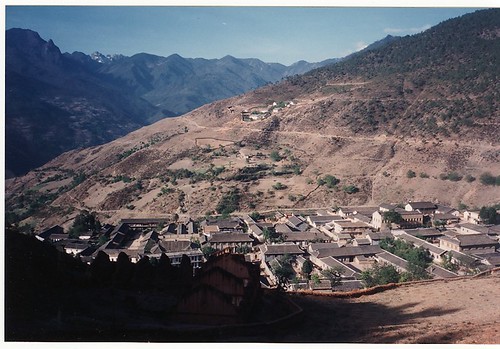

Wachang, originally uploaded by mutikonka1.

This is the nearest town to Muli monastery. It sits on a spur, up a side valley of the Litang river canyon. The mountain ridge in the background is the one you cross over when coming from Yongning. It is about 4200 metres.

Muli: Wachang [瓦厂] main street [only street]
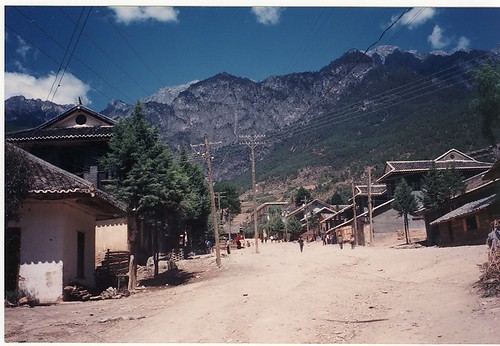

wachang street, originally uploaded by mutikonka1.

Wachang [瓦厂] is the administrative centre for the Muli monastery area. It consists of a single street with a few stores, a snack restaurant, a school and a guesthouse. That's it.

It is connected to the other towns in the Litang river valley by a rough road that winds several thousand feet down to the river below, and then corkscrews up the other side and follows a roller coaster switchback route down the the county town of "Muli" [actually known as Bowa] about 150km south. It's a wild and dangerous ride, and there are no buses.

The road to Muli: Wachang [瓦厂] at last!


wachang first, originally uploaded by jiulong.

After walking for three days from Yongning with little sign of any other towns, we eventually plodded down towards the bottom of the Litang river valley. Weary and hungry, we rounded a corner and there before us was a small white walled settlement on a spur above the valley - it was Wachang [瓦厂] - the only "town" in the upper part of the valley, and the base for exploring the Muli monastery. We had made it!

Muli hunter


muli hunter, originally uploaded by jiulong.

On the way down from the Gibboh pass we came across this chap at the timber camp who offered to take us out on a hunting trip to kill a panda. I presume he meant the more common brown panda rather than one of the rare black pandas!


Here's an earlier Muli hunter, in cermonial dress, with the same gun.

Road to Muli: at the timber camp


timber camp, originally uploaded by jiulong.

On the way down from the Gibboh pass in 1996 we stopped off at a timber camp about half a day's walk up the valley from Wachang. It was just a rough brick building with a fire. The local Tibetan and Pumi guys welcoimed us and gave us a feed [as yoou can see here]. On the way back we stopped there for the night, sleeping on the table tennis table to avoid the concrete floor - very cold it was too.

Thursday, February 24, 2005

Having a break: above Muli.
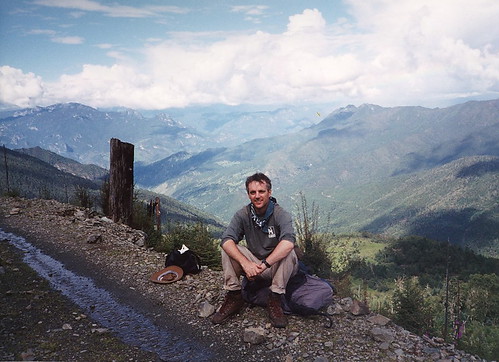

On the road to Muli, originally uploaded by mutikonka1.

I set off from Wujiao at 8am and made it this far by the late afternoon. I was still about four hours walk down to Wachang (the main village near Muli monastery). There is a timber camp a bit further down where I was planning to camp for the night. but by chance a jeep came past [the only traffic of the day] and took us the last few km. We did, however, get stuck crossing while a river on the way. Which probably explains why there was no traffic on this "road"


stuck in river
Shortly afterwards we got stuck while fording a river on the way down to Muli. Had to shift a few boulders from uner the jeep.

Muli: Mt Mitzuga in cloud.
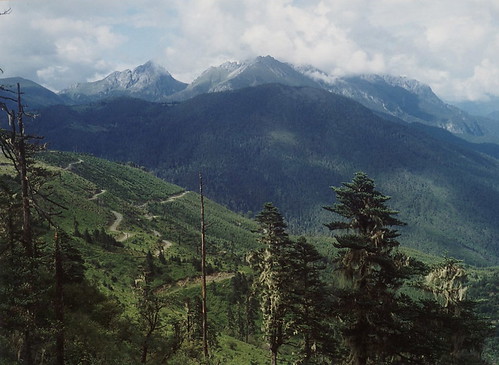

muli route2, originally uploaded by mutikonka1.

On the way down from the Gibboh pass you get great views of the 5500 m high Mt Mitzuga that towers over Muli. Everything looks very green at this time of year (August) because it's the rainy season.

"The trail led down a spur jutting out into a deep canyon in which flows the Muli river. To the left a high range, crowned by volcanic cones of perfect shape, testified to the mighty volcanic upheavals that once occurred here."

The road to Muli: looking down from the Gibboh Pass.
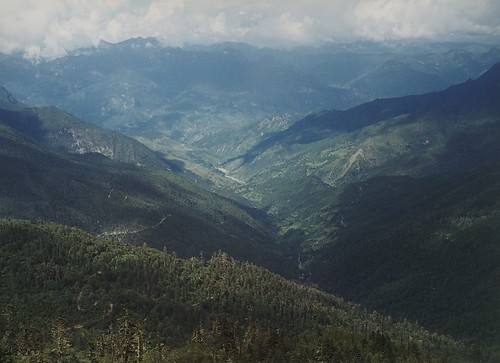

muli view, originally uploaded by mutikonka1.

The road zigzags down from 4500m towards Wachang.
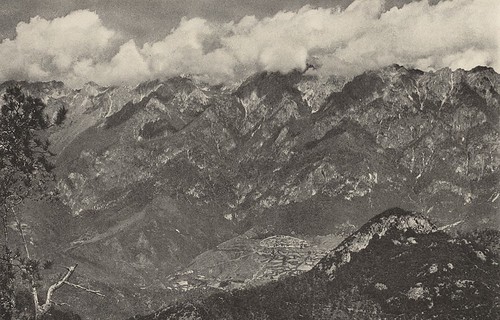


This is a picture that Joseph Rock took from the opposite direction, from the eastern bank of the Litang river valley, towards Muli. You can see the monastery complex circled by a wall.
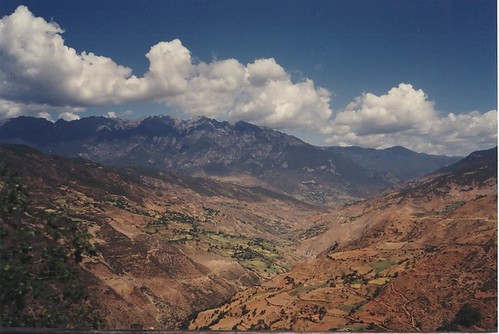
Here is some similar views taken from the back of a truck as I left Muli in 1994.
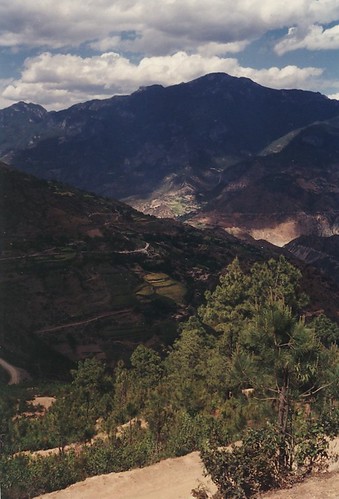
View of Muli valley from the Gibboh pass
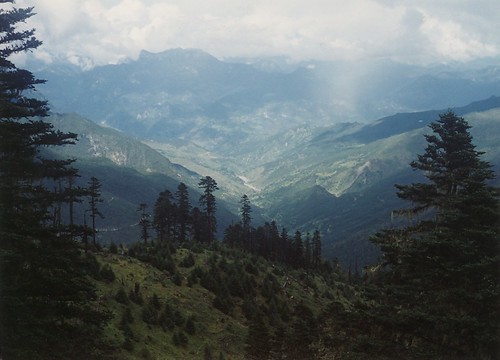

muli view2, originally uploaded by mutikonka1.

This is the view you get from the pass down towards Wachang and the Litang river.

"We descended through a steep forest of spruce and fir, with rhododendron trees as underbrush; lichens and mosses covered trunks and boulders. All was hushed.”

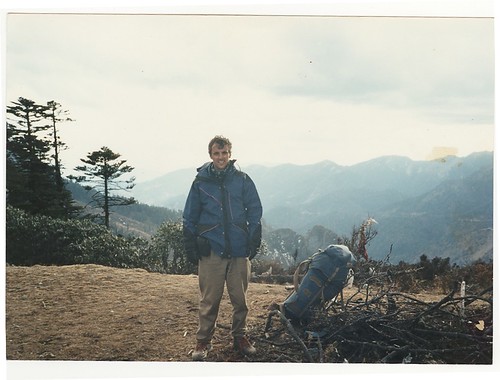
Made it! At the Gibboh Pass.

pooped, originally uploaded by mutikonka1.

At the Gibboh pass I felt like my lungs were going to burst. It was 4500 metres high and the last hour was a killer. A nice spot once you got up there though.

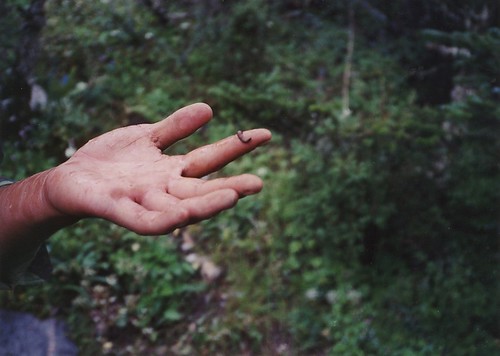
Leeches

leeches, originally uploaded by mutikonka1.

Leeches cling to the rocks and branches at the high altitudes and attach to your skin very easily. You can't feel them.

Leeches - a hazard on the way
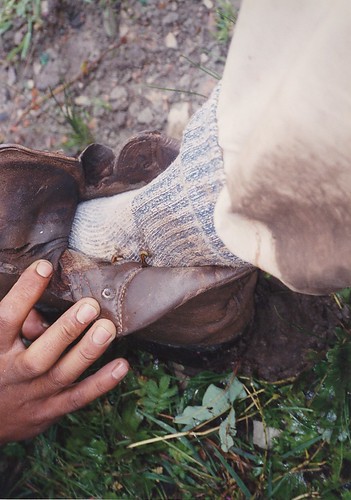

leeches2, originally uploaded by mutikonka1.

As we neared the pass at about 4000 meters in the rain I was told by my guide to check for those "blood sucking things". I thought he meant mosquitoes, until he told me to check my socks. This is what I found.

The road to Muli: over the Gibboh pass
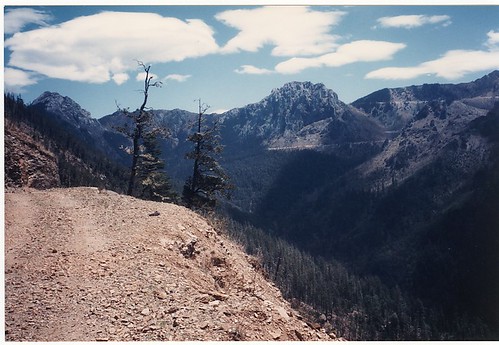

road to muli, originally uploaded by mutikonka1.

This is the jeep track that twists over the Gibboh pass from Wujiao to Muli. It goes the long way round, and it's actually quite a bit quicker to go on foot along the valley bottom to avoid all the switchbacks. But then you get a super big climb at the end of the day over that lump of rock you can see on the horizon.

On this picture if you look carefully you can see the road zig-zagging over the pass. My, that was a big walk. And somehow, on my first trek to Muli I managed to do it all in a day. I must have been fit in those days!


Forest huts near Muli
On the way up to the pass during my second trip - in the wet season - I was guided through the valley by a man from Wujiao. Here are some of the huts [unoccupied] that we paused at before ascending to the Gibboh Pass.
Muli porter2
My guide and porter.

The road to Muli, Stage 3: Renjom Gompa
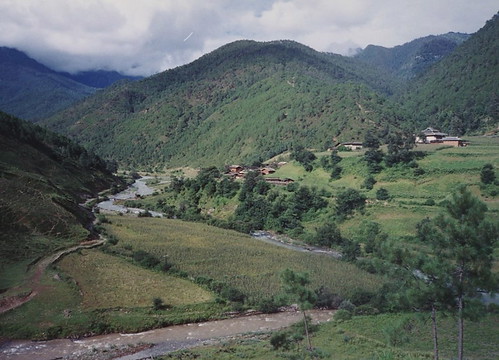

Renjom Gompa, originally uploaded by mutikonka1.

This is the tiny Buddhist monastery of Renjom Gompa, situated in a beautiful valley half way between Yongning and Muli. It is a day's trek over low hills to get here from Yongning, via the log cabin villages of Wulabi and Lijiasun.

Joseph Rock passed this way many times on his visits to Muli and mentions the monastery with its lonely monk in residence.

Spirit tree, Renjom Gompa
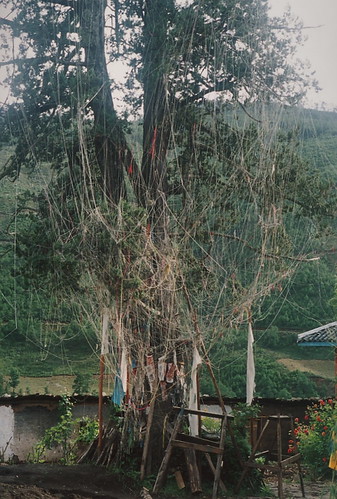

shrine tree, originally uploaded by mutikonka1.

It has threads tangled up in its branches. A shrine to the weather gods.
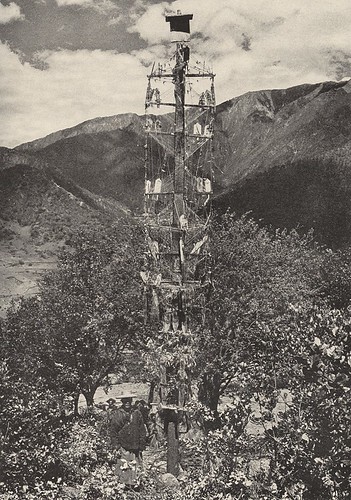


Joseph Rock saw something similar in 1926: "a scarecrow to ward off evil weather" he wrote. "The structure resemblling a primitive radio tower was erected by Hsifan sorcerers. These towers are built once in every three or four years and are believed to be especially effective as protection against hail."
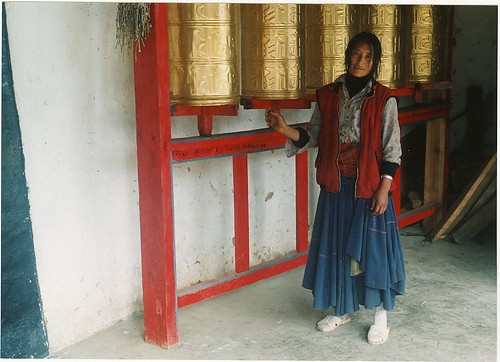
Pumi woman at Renjom Gompa, 2003


renjom wheels, originally uploaded by mutikonka1.

She is one of the helpers at the monastery.

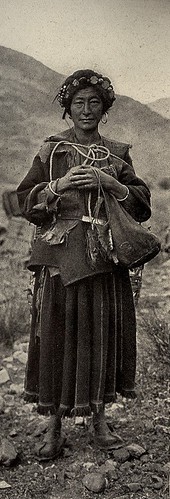
Pumi women, 1924


pumi women, originally uploaded by mutikonka1.

As seen by Joseph Rock, near Muli.

Monk and helper, Renjom gompa


Renjom interior, originally uploaded by mutikonka1.

These very nice people entertained me for afternoon tea during my brief visit. Wish I could have stayed there instead of Wujiao, but I'd left my bags back at the village.

Renjom gompa, near Wujiao [屋脚]
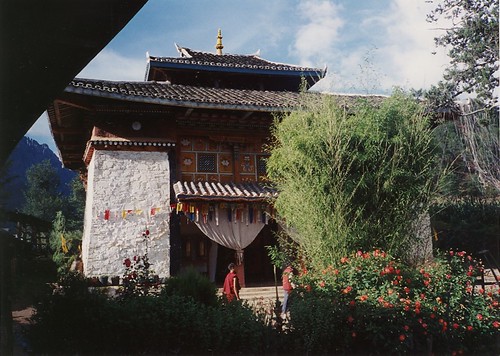

renjom gompa, originally uploaded by mutikonka1.

This is the small Buddhist monastery where Jospeh Rock stayed on his way to Muli. Now, as then, there is just one monk in residence.


renjom gompa5

Wednesday, February 23, 2005

The view from Renjom gompa

Renjom gompa, originally uploaded by mutikonka1.

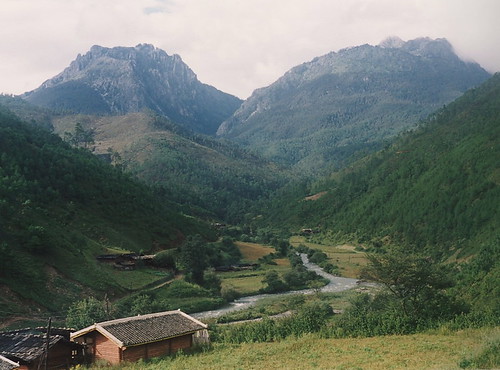
This is the view from the monastery towards the mountain pass between Yongning and Muli. The old track passes through the cleft between those twompeaks. The new jeep track skirts round the left.

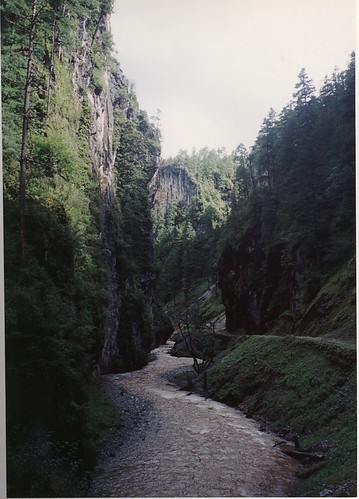
屋脚 [Wujiao]: The gorge to Renjom gompa

renjom gorge, originally uploaded by mutikonka1.

Down from Wujiao [屋脚] is a track that passes through a 1km gorge and leads to the small moanstery of Renjom Gompa.

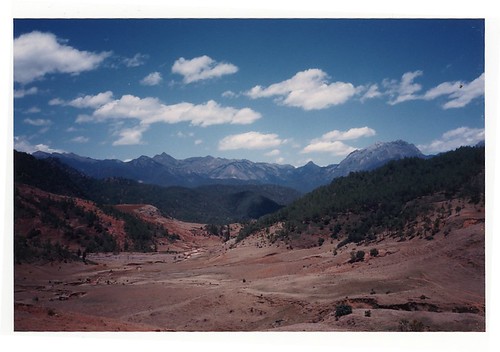
The view towards Muli

towards muli, originally uploaded by mutikonka1.

This was taken from the top of one of the many low ridges of hills between Yongning and Wujiao. The track to Muli crosses those distant mountains.This pic was taken in the spring of 1994, hence the barren and dry landscape - in contrast to the green landscape seen in the summer [wet ] season.


Nomad campfire near Muli

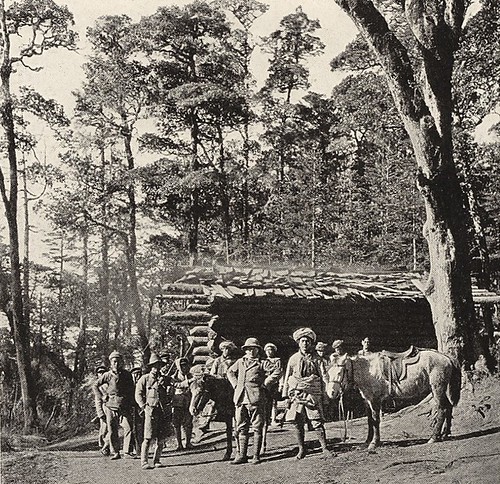
Joseph Rock near Lijiasun [利加嘴] in 1924

rock party, originally uploaded by mutikonka1.

Rock passed through this village in 1924 on his way from Lijiang to Muli.

Hay drying rack, Lijiasun [利加嘴]
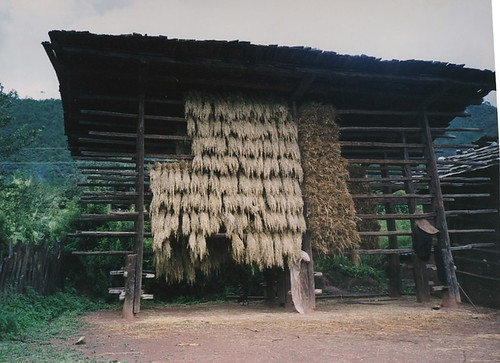

haystack2, originally uploaded by mutikonka1.

Seen in Lijiasun in the summer of 2003.
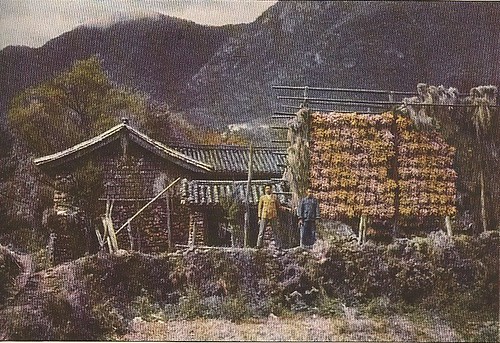


Here is a similar hay drying rack seen by Joseph Rock nearby. "Pine log racks are a feature of most farms in this district. They are used for drying corn and wheat in the open."

Lijiasun [利加嘴]
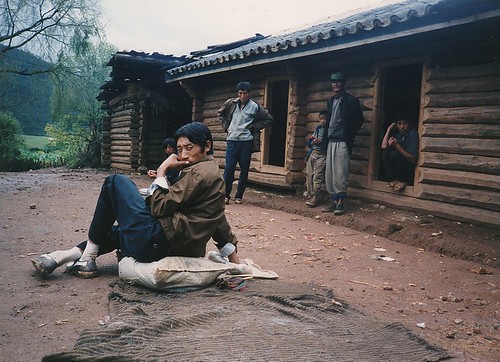

lijiasun, originally uploaded by mutikonka1.

This fly-ridden village was an uneasy stopover on the way to Muli. The local people were Yi, Naxi and Mongol, but didn't seem very happy to have me passing through.


Swastika at Lijiasun
A swastika used for its original Buddhist meaning.

Muli: the Wujiao road
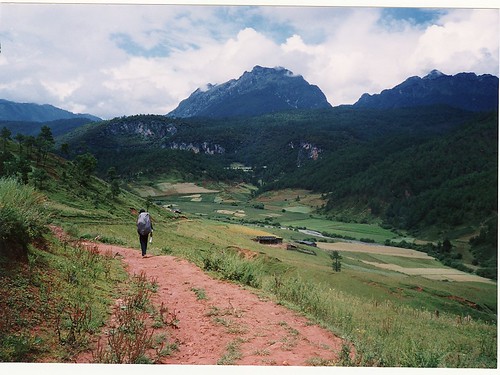

Muli: the Wujiao road, originally uploaded by mutikonka1.

This is the track you follow from Yongning to Muli. On the first day it goes via a Mongol village of Lijiasun, to Wujiao. It's an almost medieval lifestyle around here - no electricity, very rural, everything done by hand.

Hot springs at Yongning (Wenquan) 温泉, 泸沽湖
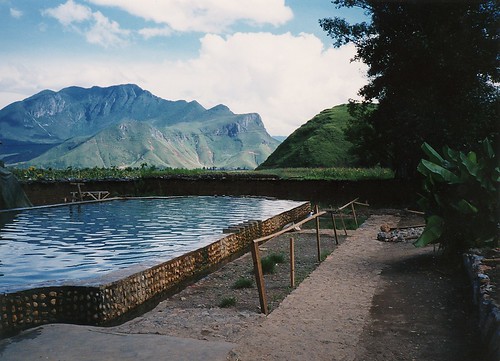

Hot springs at Yongning, originally uploaded by mutikonka.

Leaving Yongning for Muli, it is a two-three walk to the hot springs [wenquan] on the eastern edge of town. There is now a "resort" here where pools have been built for tourists. There will probably be other pools built by the time you read this.

The pools are near the village of Wulabi, and it is here where you leave the road and head out across the low hills towards Lijiasun and Wujiao - the first night's stop on the way to Muli.


Saturday, February 19, 2005

Yongning priest, 1928
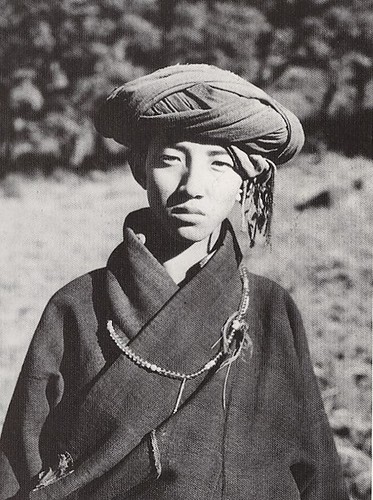

yongning priest, originally uploaded by mutikonka1.

A young Bonpo priest from Zuosuo, near Yongning, where the Bonpo school predominates - Joseph Rock.
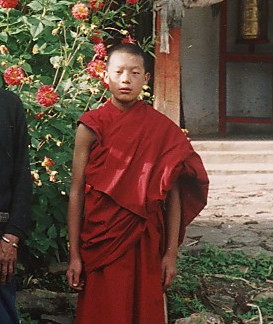
Yongning priest 2004


renjom gompa people_1, originally uploaded by mutikonka1.

This was one of the monks at the monastery between Yongning and Muli in 2004.

In the Yongning hills


camp fire, originally uploaded by mutikonka1.

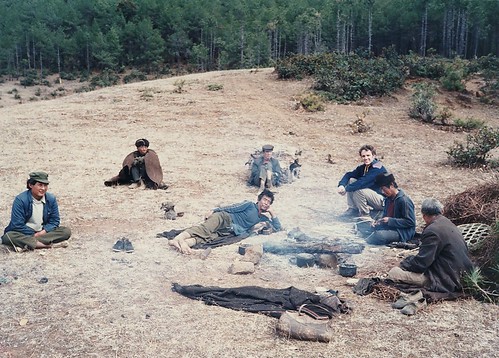
Not quite the ceremony seen below - this is the nearest I can get to showing people on the Yongning plain. It's some local Pumi having a brew in the hills just above Yongning.

Dispelling the tummy troubling demon: Naxi priests (domba) of Yongning
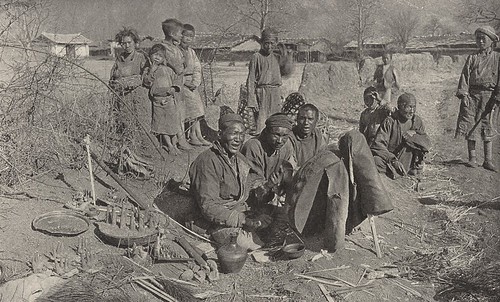

yongning domba, originally uploaded by mutikonka.

According to Rock these are "a group of Lushi Tombas, or witch priests, seated on the Youngning plain".

These domba "are engaged solely for the purpose of dealing with and driving out eveil spirits which cause bad luck, illness."

These ones have various drums, bowls full of dough gods, and they are performing their rites in front of an altar of pine sticks and oak branches, with perforated poaper smeared in pig's blood.

"They were concerned with driving out of a devel who had caused a stomach ache in a village headman," according to Rock.

The old man of Yongning

lu zuo, originally uploaded by mutikonka.

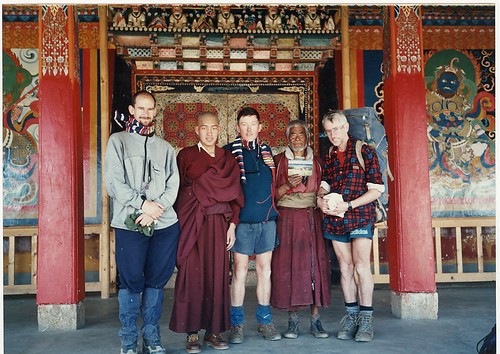
When we visited Yongning monastery in 1996 on our way to Muli we met Lu Zo who was by then an old man in his seventies.

Lu Zo is still the head lama at Yongning.

He is second from right in this picture, accompanied by a younger monk from the rebuilt monastery [and a couple of my kiwi companions]. See further down this blog for how the monastery itself looks now and 70 years ago.

An oracle seen at Yongning, 1928
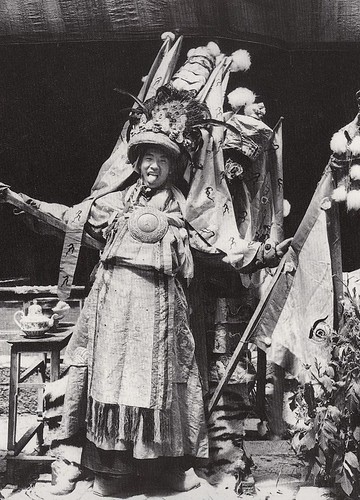

oracle, originally uploaded by mutikonka1.

The oracle (sungma) of Yongning - at the moment of possession he shakes, trembles, rolls his eyes, barks and sticks out his tongue. The metal mirror onhis chest reveals the image of the approaching spirit, Dorje Drakte.

[Joseph Rock]
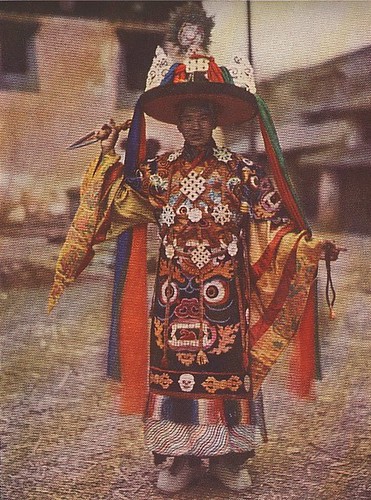

sleeves
"He commemorates a deed of violence": Sorcerers dance with spirit daggers in hand to celebrate the assassination of an ancient royal persecutor of Buddhism. Youngning.
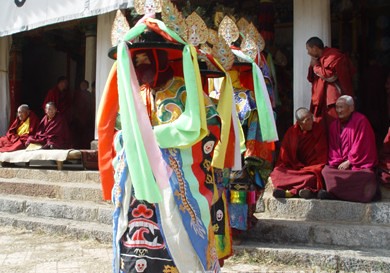
yongning hats
The same sorcerers costumes are still paraded today. But are they the real thing?

Oracle at Yongning, 1928


oracle2, originally uploaded by mutikonka1.

The oracle of the deity Dorje Drakte stands on a tiger skin rug holding a bow, noose, and sword. During his posession he conveys mesages or instructions from the deity.
[Joseph Rock]

Chanting master of Yongning, 1928


chanting master, originally uploaded by mutikonka1.

Also know as an umdze

Yongning monks 2003


yongningmonk2, originally uploaded by mutikonka1.

The monastery was almost deserted when I visited in 2003. The master, Lu Zo (see earlier posts) was away in Ninglang, and the other monks were away "studying". It was like a ghost town. These momnks were looking after the place.

Present day monks of Yongning - 2003


yongningmonk1, originally uploaded by mutikonka1.

These monks in mufti were interested in my old photographs - but not in having their own photos taken.

"His ancestors marched with Kublai Khan"


yellow lama, originally uploaded by mutikonka.

The chief of Yongning, 1928.

"When the great Mongol Emperor marched through the territory about Youngning in AD 1253 he left one of his relatives to rul the Hlihin tribesmen. The gentleman astride the pony proclaims himself a direct descendent of that first Mongol ruler." - Joseph Rock

Chief of Yongning, 1928.


yellow3, originally uploaded by mutikonka.

This paternal headman of the Mosuo town of Yongning in the 1920s was to become one of Joseph Rock's few friends in China.


yongning bloke
A modern day chief of Yongning

Wife and children of the Yongning chief, 1928.


withinfant, originally uploaded by mutikonka.

"He controls the Youngning people and lives on the islet of Nyorophu."

Bright colours appeak strongly to the Hlihin heart and eye"


mosuo color, originally uploaded by mutikonka.

Aristocratic Mosuo women in Youngning, 1928. "So precarious are the conditions i their home city that costumes and jewelry were kept on an island in Youngning [Lugu] Lake for fear of raids byt he Konkaling bandits."

Mosuo mother and daughters 1928


daughters, originally uploaded by mutikonka.

From Youngning. They rate a little lower on the social scale than the aristocratic women shown above.

"Feminine aristocrats of Youngning" 1928


mosuo5, originally uploaded by mutikonka.

"Their embroidered jackets are of satin, embellished with silver and gold. The huge erarings are silver and attached to a starnd of hair."

Young men of Yongning, 1928


yongning youth, originally uploaded by mutikonka.

"Hlihin tribesmen arrayed for battle"

"Resident of Youngning, they must constantly be on alert against attacks by the Konkaling bandits. The man at the centre is the chief's son."

Royal guard, Yongning, 1928


yongning soldier, originally uploaded by mutikonka1.

A royal guard of Yongning. Red lacquered pigskin armor such as this is thought to have been worn by warriors since the 13th century.

[Many of the Yongning people ae Mongols, descended form the soldiers of Kublai Khan who came here to restore order in the 13th century.)

The prince of Yongning and his men, 1928


yongning prince, originally uploaded by mutikonka1.

According to Joseph Rock this is "Moso men of Yongning in battle dress. At centre is a local prince."

Wednesday, February 16, 2005

Road to Muli, stage 2: Yongning


yongning first, originally uploaded by mutikonka1.

To continue my description of the road to Muli from Lugu Lake, the second stop is at the village of Yongning. This is about 20km north of the lake, round the back of Lion Mountain. It's possible to get bus drivers to take you on if they come from Lijiang - for a fee. Otherwise, nobody much comes to Yongning, it's the end of the line - there is no road on from here, except for a very rough 4WD/tractor track that winds over the 4500 m mountains to Muli. But there is no traffic on that.

You can spend a nice couple of days around Yongning, exploring the Zhamei Si monastery [see below] and enjoying a dip at the hot springs about 5km out of town to the east.

Joseph Rock spent a lot of time here between 1923 and 1933, mainly because he liked the company of the local chief or tsungkuan called A Yung Shan.

He preferred him for his relative;y benign and paternalistic rule over the Yongning people [compared to the despotism of Muli] and live and let live" attitude. Yongning had a yellow hat monastery but its isolation also encouraged a rather relaxed atmosphere, where monks took wives and rarely visited the monstery except for special festivities!

Rock spent a lot of his time at A Yung Shan's private retreat on the island of Nyorophu in the middle of Lugu Lake [see below]. The chief died in 1933, and Yongning fell under the Chinese influence of Yunnan warlord Lung Yun. When Rock paid a visit in 1942 many of the local fields had been turned over to growing opium.

Gateway to Zhamei Si monastery, Yongning


zhamei gate, originally uploaded by mutikonka1.

As seen in 2003.

Gateway to Yongning monastery (interior)


yongning gate, originally uploaded by mutikonka.

A very serene place this. Where was everyone?

Dormitory rooms at Yongning monastery


yongning dorms, originally uploaded by mutikonka.

There were only about five monks staying on my last visit in August 2003. You can see Lion Mountain in the bakground.

Yongning monastery 2003


Yongning monastery, originally uploaded by mutikonka.

Yongning 1926


Yongning 1926, originally uploaded by mutikonka.

Yongning ceremonies, 1928 and 2004


KIF_1108, originally uploaded by mutikonka1.

"A huge applique thangka of Tsongkhapa displayed at Youngning monastery to celebrate his festival." - Joseph Rock


yongning4
A similar ceremony being held in 2004.
yongning thanka
Note the same thangka as in the first picture
dancers color
"Lamas make the demons of hell seem very real" From left to right they represent the yak, or bron; the deer; Yama, the king of hell, and Tsametthre, his wife.
devil dancers6
"Youngning lamas don weird masks in preparation for a religous dance."
devil dancers2
"They serve the prince of darkness": the two outside figures represent the deer, or showa spirits. All of them help the prince of the netherworld in torturing the souls of departed beings.
head
"Impersonator of the Showa frighten pious Tibetans": together with the yak and a gruesome retinue of living skeletons, he appears in many of the lama dances as a lieutenant of Yama, the king of hell.
goathead
A good demon: this deity of the white lama sect in Youngning holds a drum in one hand and a human thigh bone in the other.

Here are some pictures of a similar ceremony being held at the rebuilt Zhamei temple in 2004:

yongning10

yongning9

yongning5

yongning6

yongning7

yongning12

dobdob
Tibetan lama prefects - dobdob - keeping order at the monastery in 1924.

yongning11
A modern day dobdob at Yongning

Zhamei Si, Yongning, 2003


zhamei front, originally uploaded by mutikonka1.

Compare this empty monastery to the thriving one in the picture above. Now there are only a handful of monks at this monastery which is a satellite of the much bigger one at Muli.


Zhamei Si side view
Zhamei Si: this is the only remaining building from the monastery that Joseph Rock visited. All the others have been rebuilt.

Zhamei Si monastery, 2003


yongning cu, originally uploaded by mutikonka1.

From the east.

Zhamei Si monastery, Yongning, 1994


yongning monastery, originally uploaded by mutikonka1.

At this time the monastery was still under construction.

Yi women of Yongning, 1924


yi likiang, originally uploaded by mutikonka1.

These women are posing in front of a log cabin of the characteristic style still seen near Yongning in 1924.

Yi women if Yongning in 1996


me with yi, originally uploaded by mutikonka1.

These lovely ladies of Yongning were persuaded to take a happy snap with yours truly during our trip of 1996. They aren't dressed up for a special occasion - the local women always wear stuff like this.

Yi people have a reputation for being rather wild - and some say the descended from the Roman or Persian warriors who attacked China's border areas a thousand years ago. Maybe it's true. Some have high aquiline noses and light coloured eyes.

The mortar board hat is characteristic of the Yi.

They used to be a slave owning society with Black Yi masters and White Yi slaves. Lefty journalist Alan Winnington wrote an interesting book about it in the 1940s, called Slaves of the Cool Mountains.

Women of Yongning, 1916


No not by Joseph Rock, this time it is a picture taken ten years earlier by another botanist, Heinrich Handel-Mazzetti. You can see the whole book at:

www.paeo.de/h1/hand_maz/pioneer/buch.html

Yongning women, 1924


yongning girls1, originally uploaded by mutikonka.

This is a photo by Joseph Rock of a Lushi [Mosuo] family in Yongning, 1924.

"On their heads the women wear strings of amber or in the absence of amber, yellow coloured wooden spools interspersed with black and red ones."

Yongning shopfront


yongning2, originally uploaded by mutikonka.

As with most of the shops in Yongning, this is a simple hole in the wall affair. You can see a few Yi women in the foreground.

Yongning, 1994


yongning, originally uploaded by mutikonka1.

About 20km north from Lugu Lake is the small market town of Yongning. This was a speacial place for Joseph Rock, who was good friends with the local tulku, or head monk, of the Yongning monastery. In his biography, it is said that the tulku was one of the few real friends that Rock ever had.

Yongning is a melting pot of different nationalities - mostly Mosuo but with Naxi, Mongol [from the emigrations of the 13th century] and as this picture shows, many Yi people.

Nowadays Yongning is a one street town with the rebuilt Zhamei Si monastery as its main attraction.

Tuesday, February 15, 2005

The way to Muli: Lugu Lake, 2004


lugu, originally uploaded by mutikonka.

Over the next few days and weeks I will publish an account of my trips from Lugu Lake to Muli. I have had a few people email me asking for details, so this way I will be able to talk about the route and show some pictures - both old an new.

The starting point is Lugu lake, which is now reachable in a day from Lijiang and its international airport. I won't say too much about Lugu and its very famous Mosuo people, the walking marriages etc. You can read about that elsewhere. It's a nice place to hang out, but the main village is very touristy. There is a more alternative couple of guesthouses run by young han Chinese outsiders, at the north end of the lake.

On my last trip to Muli I bypassed Lugu Lake altogether - except to take this picture - and travelled direct to Yongning. More of that in the next post.

Lugu Lake 1924 and 2004


lugu rock, originally uploaded by mutikonka.

Taken by Joseph Rock. As published in his article "Land of the Yellow Lama"; Nat Geo, April 1925.


lugu2
The view from the same spot last year

The road to Lugu Lake, 1994


luguroad, originally uploaded by mutikonka.

When I visited Lugu in 1994 the bus service was non-existent, and I travelled in a private van that pitched up and down so much I was violently travel sick. Or perhaps it was the roadside pancake I ate in Ninglang.

Whatever, my introduction to Lugu Lake was not a pleasant one. I stayed a day and a night in bed before seeing it through more appreciative eyes.

"It was a precarious situation": Joseph Rock on Nyorophu, 1924


nyorophu, originally uploaded by mutikonka.

Here is the grand explorer, living in style on the island of Lugu Lake after being pursued by angry robbers from Konkaling (Yading) who blamed his visit for disastrous hailstorm that ruined their crops:

"When I reached [Yongning] I learned to my consternation that the ferries across the Yangtze had been smashed and that it would be impossible for us to continue to our Nashi village of Nguluko. The reason was that 8,000 rebe;swho had planned to take the capital of Yunnan had been driven west and now occupied Youngning territory.

So for two months I remained marooned on an island in Youngning Lake, threatened by the Konkaling bandist from the northwest and the rebel forces from the south. It was a precarious situation."


Here is a more recent picture of a smaller restored building by yingzhao:

Making dugout canoes at Lugu Lake, 1994


lugucanoe, originally uploaded by mutikonka.

When I first visited Lugu lake it was already gearing up for the influx of tourists. At that time there were one or two homestay style guesthouses where you kipped in simple rooms by the shore. That was it. I understand now that tourism is big business in Lugu lake and some of the guesthouses look like Las Vegas casinos (OK I'm exaggerating, but you get the idea).

One of the tourists things is to ride out to the island on a canoe. When I saw the locals paddlling out in these dugouts to catch their daily quota of sprats they reminded me of maori in their waka canoes, songs and all.

Lugu lake shore, 1994 and 1928


lugulakeshore, originally uploaded by mutikonka.

You can see Lion Mountain in the background.


.
Here is the shore of the Nyorophu Island, with tree branches placed in the water to deter landings by bandits

The temple on Nyorophu island, Lugu Lake, 1924


nyrophu2, originally uploaded by mutikonka.

"The house was built mainly as a place of refuge should Youngning be attacked by brigands or the hostile neighboouring Lolo" - Joseph Rock, 1924.

Lugu Lake and Lion Mountain, 1924


nyrophu3, originally uploaded by mutikonka.

Taken by Joseph Rock, this shows the lake and the island where he made his base, Nyorophu.

Monday, February 14, 2005

Lugu Lake, spring 1994 and 1928


lugufield, originally uploaded by mutikonka.

I remember the cuckoos were singing when I took this picture.


Here is an autochrome picture of Lugu Lake taken by Joseph Rock in 1928.

Dancers at Lugu Lake


lugudancers, originally uploaded by mutikonka.

These are Mosuo dancers doing a jig for the tourists at Luoshui, the main village at Lugu Lake, in 1994.